
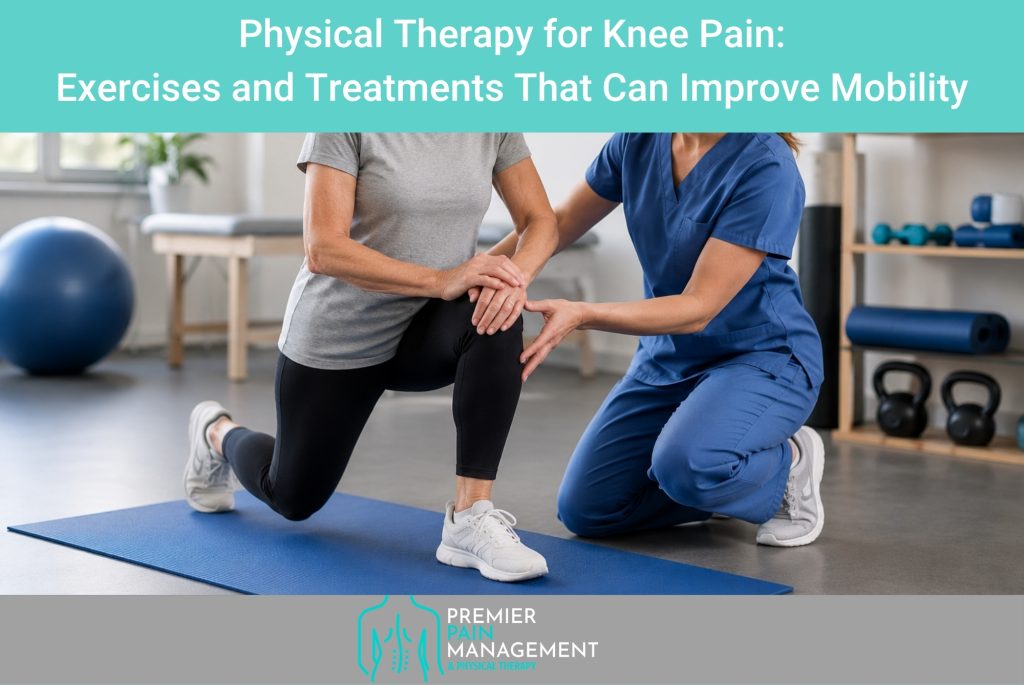
Knee pain can make even simple activities—walking, climbing stairs, getting out of a chair, exercising, or standing for extended periods—more difficult. Because the knee is a major weight-bearing joint, pain or stiffness can have a significant impact on mobility, independence, and overall quality of life.
Physical therapy is a conservative treatment option commonly used to address many causes of knee pain. Rather than focusing only on the location of discomfort, physical therapy evaluates how the muscles, joints, movement patterns, flexibility, balance, and biomechanics surrounding the knee may be contributing to symptoms.
At Premier Pain Management in Highlands Ranch, Colorado, patients with knee pain can receive an individualized evaluation to determine the underlying source of their symptoms and which treatments may be appropriate. Physical therapy may be recommended independently or incorporated into a broader pain-management plan designed to improve function, reduce discomfort, and help patients return to everyday activities.
Why Does Knee Pain Occur?
The knee is a complex joint formed primarily by the femur (thighbone), tibia (shinbone), and patella (kneecap). Cartilage, menisci, ligaments, tendons, muscles, and other soft tissues work together to provide stability while allowing the knee to bend, straighten, and absorb forces during movement.
Problems involving any of these structures can potentially cause pain.
Common Causes of Knee Pain
Knee pain may develop because of an acute injury, repetitive stress, age-related changes, altered biomechanics, or an underlying medical condition.
Common causes include:
- Osteoarthritis
- Patellofemoral pain syndrome
- Meniscus injuries
- Ligament sprains or tears
- Tendinitis
- Bursitis
- Muscle weakness or imbalance
- Overuse injuries
- Iliotibial band-related pain
- Previous knee injuries
- Reduced hip or ankle mobility
- Poor movement mechanics
- Sports-related injuries
Because different knee conditions require different approaches, obtaining an accurate diagnosis is an important first step before beginning an exercise or rehabilitation program.
How Physical Therapy Can Help Knee Pain
Physical therapy is designed to improve the body’s ability to move and function. For knee pain, treatment commonly focuses on restoring strength, flexibility, range of motion, balance, coordination, and movement efficiency.
Reducing Stress on the Knee Joint
Weakness or restricted mobility in one part of the lower extremity can alter how forces travel through the knee.
For example, weakness in the quadriceps or hip muscles may affect knee alignment during walking, squatting, or climbing stairs. Improving strength and movement mechanics may distribute forces more effectively and reduce unnecessary stress on painful structures.
Improving Knee Range of Motion
Pain, swelling, arthritis, injury, or prolonged inactivity can limit the ability to fully bend or straighten the knee.
Physical therapy may use targeted exercises and mobility techniques to gradually restore range of motion. Improved mobility can make activities such as walking, sitting, and climbing stairs easier.
Strengthening Muscles That Support the Knee
The knee does not function independently. Muscles throughout the hips, thighs, lower legs, and core influence how the knee moves.
A rehabilitation program may therefore strengthen several muscle groups rather than concentrating exclusively on the knee.
Improving Balance and Stability
Pain or injury can affect proprioception—the body’s awareness of joint position and movement.
Balance and stability exercises can retrain neuromuscular control, which may be particularly important for people recovering from injuries or experiencing knee instability.
Improving Functional Mobility
The ultimate goal of physical therapy is not simply to perform exercises successfully in a clinic. Treatment should help patients perform meaningful everyday activities more comfortably and confidently.
Depending on the patient, functional goals might include walking farther, climbing stairs, returning to work, playing sports, exercising, gardening, or getting up from a chair without significant discomfort.
Physical Therapy Exercises Commonly Used for Knee Pain
There is no single exercise program that is appropriate for every person with knee pain. Exercises should be selected according to the diagnosis, physical examination, functional limitations, age, activity level, and treatment goals.
Some commonly used categories include the following.
Quadriceps Strengthening
The quadriceps muscles at the front of the thigh play an important role in extending and stabilizing the knee.
Exercises may include:
- Quadriceps sets
- Straight-leg raises
- Short-arc knee extensions
- Sit-to-stand exercises
- Step-ups
- Modified squats
Strengthening these muscles may improve knee control and support during weight-bearing activities.
Hamstring Strengthening
The hamstrings at the back of the thigh help bend the knee and contribute to lower-extremity stability.
Depending on the patient’s condition, therapy may incorporate controlled hamstring curls, bridges, or other progressive strengthening exercises.
Hip and Gluteal Strengthening
Hip strength can significantly influence lower-extremity alignment.
Weak hip abductors and gluteal muscles may contribute to excessive inward movement of the knee during activities such as squatting, running, or descending stairs.
Exercises may include:
- Bridges
- Side-lying leg raises
- Hip abduction exercises
- Resistance-band exercises
- Lateral stepping
- Controlled single-leg activities
Calf Strengthening
The calf muscles contribute to walking, balance, and lower-extremity mechanics.
Calf raises and similar exercises may be incorporated into rehabilitation when appropriate.
Range-of-Motion Exercises
Patients with stiff knees may benefit from exercises designed to gradually improve flexion and extension.
Examples may include:
- Heel slides
- Assisted knee bending
- Gentle knee-extension exercises
- Stationary cycling with appropriate resistance and positioning
These exercises should generally be performed within the limits recommended by a healthcare professional.
Flexibility Exercises
Tight muscles surrounding the hip, thigh, and lower leg can influence knee mechanics.
A physical therapy program may incorporate stretching for the:
- Hamstrings
- Quadriceps
- Calves
- Hip flexors
- Other surrounding soft tissues
Stretching should be controlled rather than aggressive, particularly when the knee is acutely painful or injured.
Balance and Proprioception Exercises
Balance exercises may begin with basic supported standing and progress toward more challenging activities.
Examples include:
- Single-leg standing
- Weight shifting
- Controlled step exercises
- Balance-pad exercises
- Functional stability drills
The appropriate difficulty depends on the patient’s condition and fall risk.
Low-Impact Exercise for Knee Pain
Movement can be beneficial for many people with knee pain, but exercise does not necessarily need to involve high-impact activities.
Walking
For some patients, appropriately paced walking can help maintain cardiovascular fitness and joint mobility. Distance and intensity may need to be adjusted according to symptoms.
Stationary Cycling
Cycling provides repetitive knee movement with relatively low impact. It may be incorporated to improve mobility, endurance, and lower-extremity conditioning.
Aquatic Exercise
Water reduces the amount of body weight transmitted through the lower extremities. Pool-based exercise can therefore provide an alternative for some people who find land-based activities uncomfortable.
Elliptical Training
Some patients may tolerate elliptical exercise better than running because it produces less repetitive impact. Suitability depends on the underlying knee condition.
Other Physical Therapy Treatments for Knee Pain
Exercise is a central component of many rehabilitation programs, but physical therapists may use additional techniques depending on the patient’s condition.
Manual Therapy
Manual therapy involves hands-on techniques designed to address joint mobility, muscle tension, or soft-tissue restrictions.
When combined with therapeutic exercise, these techniques may help certain patients improve mobility and function.
Gait Training
Knee pain can change the way a person walks. Limping or compensating for pain may place additional stress on the hip, ankle, opposite knee, or lower back.
Gait training focuses on improving walking mechanics and, when necessary, teaching appropriate use of assistive devices.
Movement and Biomechanical Training
A therapist may evaluate how a patient performs activities such as:
- Squatting
- Walking
- Running
- Climbing stairs
- Lifting
- Jumping and landing
- Changing direction
Movement retraining can be particularly valuable for active individuals and athletes.
Activity Modification and Education
Recovery does not always require complete rest. In many situations, modifying an activity is preferable to eliminating movement entirely.
Patients may receive guidance regarding exercise intensity, activity progression, workplace ergonomics, footwear, recovery, and strategies for managing symptoms.
Physical Therapy for Knee Osteoarthritis
Knee osteoarthritis occurs when changes within the joint—including deterioration of articular cartilage and other structural changes—contribute to pain, stiffness, and reduced function.
Exercise-based therapy is frequently incorporated into conservative osteoarthritis management.
Why Exercise Matters for Arthritis
Pain can cause people with arthritis to become less active. Unfortunately, prolonged inactivity can contribute to muscle weakness, reduced endurance, and further loss of mobility.
A carefully structured exercise program can help maintain or improve:
- Muscle strength
- Joint mobility
- Walking ability
- Balance
- Physical conditioning
- Functional independence
The goal is to provide an appropriate level of activity without unnecessarily aggravating symptoms.
Physical Therapy After a Knee Injury
Knee injuries may involve the ligaments, meniscus, tendons, muscles, cartilage, or bones.
Rehabilitation depends heavily on the specific injury.
Early Rehabilitation
During the earlier stages of recovery, treatment may emphasize controlling symptoms, maintaining safe mobility, restoring range of motion, and preventing excessive muscle loss.
Progressive Strengthening
As healing progresses, strengthening exercises may gradually become more demanding.
The rehabilitation program may progress from basic muscle activation to weight-bearing exercises and eventually more complex functional movements.
Return-to-Activity Training
Athletes and physically active patients may require advanced exercises involving running, jumping, landing, acceleration, deceleration, or changes in direction before safely returning to their previous activities.
Return to activity should be based on recovery and functional ability rather than simply the amount of time that has passed since an injury.
Can Physical Therapy Help Avoid Knee Surgery?
Physical therapy may help some patients manage knee pain without surgery, depending on the underlying condition and its severity.
Conservative care may be considered for conditions such as osteoarthritis, overuse injuries, muscle weakness, patellofemoral pain, and certain soft-tissue injuries.
However, physical therapy cannot repair every structural problem. Severe trauma, certain unstable injuries, advanced joint damage, or other significant abnormalities may require surgical evaluation.
An individualized medical assessment can help determine whether conservative treatment is appropriate.
Physical Therapy Before and After Knee Surgery
Physical therapy can also play an important role when surgery is necessary.
Prehabilitation Before Surgery
Some patients participate in physical therapy before an operation to improve strength, mobility, and physical conditioning.
Entering surgery with better function may make certain aspects of postoperative rehabilitation easier.
Rehabilitation After Surgery
Postoperative rehabilitation may focus on:
- Restoring range of motion
- Improving muscle activation
- Rebuilding strength
- Reducing functional limitations
- Improving walking
- Restoring balance
- Gradually returning to normal activities
The exact rehabilitation timeline depends on the surgical procedure and instructions from the surgical team.
How Long Does Physical Therapy for Knee Pain Take?
There is no universal treatment timeline.
Recovery can depend on:
- The underlying diagnosis
- Severity and duration of symptoms
- Age and general health
- Previous injuries
- Baseline strength and mobility
- Activity level
- Treatment goals
- Consistency with prescribed exercises
- Whether surgery was performed
Some relatively minor problems may improve over several weeks, while chronic conditions or significant injuries may require a longer rehabilitation period.
Progress should be assessed based on measurable improvements in pain, strength, mobility, and function rather than an arbitrary deadline.
Should Knee Exercises Hurt?
Some muscle fatigue or mild discomfort may occur when beginning rehabilitation, particularly if the muscles have become weak or deconditioned.
However, severe, sharp, rapidly increasing, or persistent pain should not simply be ignored.
An exercise program may need to be modified if an activity consistently produces significant symptoms. Patients should discuss changes in pain, swelling, instability, or function with their healthcare professional.
Why a Personalized Exercise Program Matters
Searching online for “best exercises for knee pain” can produce hundreds of recommendations, but knee pain is not a single diagnosis.
An exercise that is appropriate for one condition may aggravate another.
For example, rehabilitation for osteoarthritis may differ substantially from rehabilitation following an ACL injury, meniscus injury, patellar instability, or acute tendon problem.
A personalized evaluation allows treatment to address the patient’s actual diagnosis and functional deficits rather than treating all knee pain the same way.
When Should You Seek Medical Care for Knee Pain?
Medical evaluation is recommended when knee pain is persistent, worsening, interfering with daily activities, or associated with significant changes in function.
More urgent evaluation may be necessary for symptoms such as:
- Severe pain after trauma
- Inability to bear weight
- Significant swelling
- Obvious deformity
- A knee that repeatedly gives way
- A knee that becomes locked
- Fever accompanied by a hot, red, swollen joint
- New numbness or weakness
- Sudden severe symptoms
These findings can sometimes indicate an injury or medical condition requiring prompt assessment.
A Comprehensive Approach to Knee Pain at Premier Pain Management
Effective knee-pain treatment begins with identifying why the knee hurts.
At Premier Pain Management in Highlands Ranch, CO, evaluation can help determine whether symptoms are associated with arthritis, injury, soft-tissue dysfunction, altered biomechanics, or another source of pain.
Depending on the diagnosis, a treatment plan may incorporate physical therapy and other appropriate pain-management strategies.
The objective is not simply to temporarily reduce discomfort. A comprehensive approach seeks to improve mobility, restore function, strengthen supporting structures, and help patients participate more comfortably in the activities that matter to them.
Frequently Asked Questions About Physical Therapy for Knee Pain
Is physical therapy good for knee pain?
Physical therapy can be beneficial for many causes of knee pain. Treatment may improve strength, flexibility, range of motion, balance, and movement mechanics. Whether it is appropriate depends on the underlying diagnosis.
What are the best physical therapy exercises for knee pain?
There is no single best exercise for everyone. Common exercises include quadriceps strengthening, straight-leg raises, bridges, heel slides, step-ups, calf raises, and hip-strengthening exercises. The correct program depends on the cause and severity of the patient’s symptoms.
Can strengthening my legs reduce knee pain?
In some cases, yes. Stronger quadriceps, hamstrings, gluteal muscles, and other lower-extremity muscles can improve joint support and movement mechanics. Strengthening should be progressive and appropriate for the specific condition.
Is walking good for knee pain?
Walking can be useful for many patients, especially when performed at an appropriate duration and intensity. However, patients with acute injuries or significant symptoms may need temporary modifications.
Is cycling good for painful knees?
Stationary cycling is frequently used as a low-impact exercise because it allows repetitive knee movement without the impact associated with running. Proper seat position and resistance are important.
Can physical therapy help arthritis in the knee?
Physical therapy cannot reverse osteoarthritis, but exercise and rehabilitation can help many patients improve strength, mobility, balance, and physical function while managing symptoms.
Can physical therapy help a torn meniscus?
Physical therapy may be appropriate for some meniscus injuries, particularly when symptoms and knee stability allow conservative management. Other tears may require surgical evaluation. The location and characteristics of the tear, symptoms, age, activity demands, and associated injuries can influence treatment decisions.
Does physical therapy help patellofemoral pain?
Physical therapy is commonly used for patellofemoral pain. Treatment may address quadriceps and hip strength, flexibility, movement mechanics, activity modification, and factors influencing patellar loading.
How often should I perform knee exercises?
Exercise frequency depends on the diagnosis, exercise type, intensity, and rehabilitation phase. Strengthening exercises require appropriate recovery, while certain mobility exercises may be prescribed more frequently. Patients should follow their individualized treatment plan.
Should I rest my knee completely when it hurts?
Not necessarily. Complete inactivity can contribute to stiffness, weakness, and loss of conditioning. Depending on the injury, relative rest and activity modification may be more appropriate. Acute or severe injuries should be medically evaluated before exercise.
Can physical therapy prevent knee pain from returning?
No treatment can guarantee that knee pain will never recur. However, improving strength, mobility, balance, conditioning, and movement mechanics may address contributing factors and reduce the likelihood of certain recurring problems.
How quickly should knee pain improve with physical therapy?
Improvement varies considerably. Some patients notice changes within several weeks, while chronic or complex conditions can require longer treatment. Diagnosis, severity, overall health, and adherence to rehabilitation all affect recovery.
What happens if physical therapy does not relieve my knee pain?
Persistent symptoms may require further evaluation. Your healthcare provider may reassess the diagnosis, order diagnostic imaging when appropriate, modify treatment, or consider other conservative or interventional options.
Do I need an MRI before starting physical therapy?
Not every patient with knee pain requires an MRI. A clinical examination can often provide substantial information about the likely cause. Imaging may be recommended when symptoms, physical findings, trauma history, or response to conservative care indicate that additional information is needed.
Can older adults safely perform physical therapy for knee pain?
Yes, when appropriately prescribed. Exercise can be adapted to an individual’s strength, balance, mobility, medical history, and functional abilities. Physical therapy can be particularly valuable for maintaining independence and mobility as people age.
Can athletes use physical therapy to return to sports after knee pain?
Yes. Sports rehabilitation may include progressive strengthening, agility, balance, jumping, landing, running, and sport-specific movement training. Return-to-sport decisions should consider functional recovery and the nature of the underlying injury.
When should I see a pain management specialist for knee pain?
Consider an evaluation when knee pain persists, repeatedly returns, limits mobility or daily activities, disrupts sleep, or has not responded adequately to initial conservative measures. A comprehensive assessment can help identify the source of pain and determine appropriate treatment options.
Improving Mobility Starts With Understanding Your Knee Pain
Knee pain does not have to automatically mean giving up exercise or accepting progressively limited mobility.
For many patients, a structured physical therapy program can improve strength, flexibility, balance, range of motion, and confidence with movement. The most effective program is based on the specific reason for the pain rather than a generic collection of knee exercises.
If knee pain is limiting your ability to walk, exercise, work, climb stairs, or participate in everyday activities, Premier Pain Management can evaluate your symptoms and discuss an individualized treatment plan designed around your condition and functional goals.
Contact Information
Premier Pain Management
8671 S Quebec St. Suite 150
Highlands Ranch, CO 80130
Phone: (303) 683-6868
Website: premierpaingroup.com
Appointments: premierpaingroup.com/appointments/