
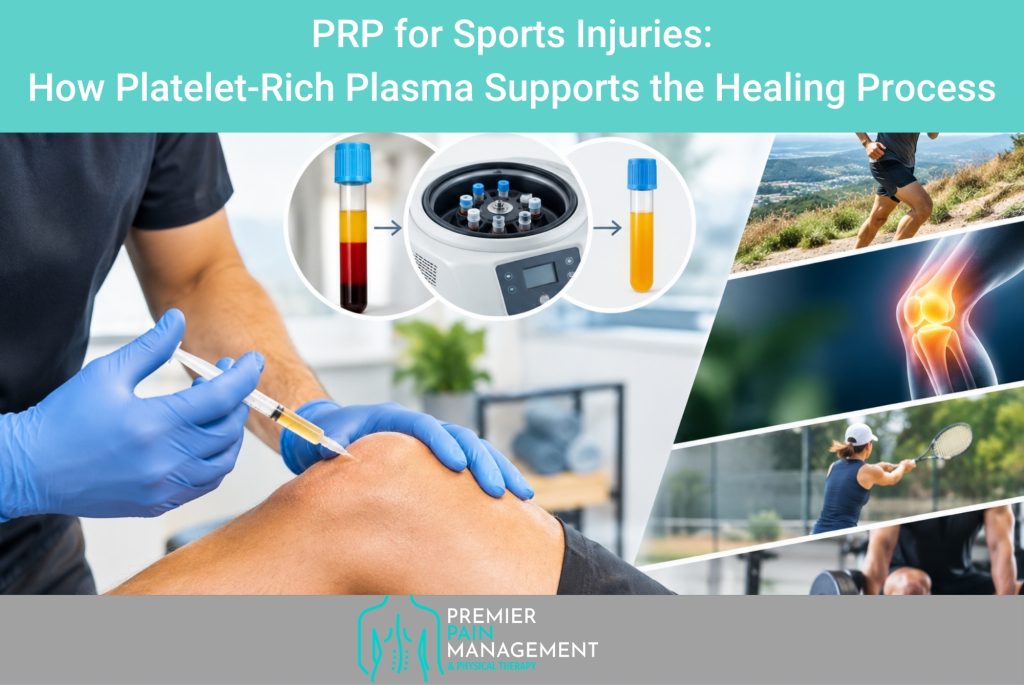
Sports injuries can affect everyone from competitive athletes to weekend runners, recreational golfers, and people simply trying to stay active. When a tendon, ligament, muscle, or joint is injured, recovery can sometimes take longer than expected because certain tissues have a relatively limited blood supply or are repeatedly stressed during everyday movement.
Platelet-rich plasma (PRP) therapy is a regenerative treatment that uses a concentrated preparation made from a patient’s own blood. PRP contains platelets and biologically active proteins involved in the body’s normal response to tissue injury. When appropriately used, PRP may help create a biological environment that supports tissue repair and rehabilitation.
At Premier Pain Management in Highlands Ranch, Colorado, patients with persistent musculoskeletal pain and sports-related injuries can receive a comprehensive evaluation to determine the source of their symptoms and whether treatments such as PRP injections may be appropriate.
What Is Platelet-Rich Plasma (PRP) Therapy?
PRP therapy is an autologous treatment, meaning the material used for the procedure comes from the patient’s own body.
A small amount of blood is collected and processed, typically using a centrifuge. Centrifugation separates the blood into different components and allows a concentrated platelet-containing portion of plasma to be prepared for injection.
The resulting PRP preparation is then delivered to the targeted area of injury.
Why Are Platelets Important?
Platelets are best known for their role in blood clotting, but they also participate in tissue repair. Activated platelets release signaling molecules and growth factors involved in cellular communication, inflammation, blood vessel formation, and tissue remodeling.
Examples of biologically active factors associated with platelets include platelet-derived growth factor (PDGF), transforming growth factor-beta (TGF-β), vascular endothelial growth factor (VEGF), and other signaling proteins.
These substances do not instantly regenerate damaged tissue. Instead, they participate in the complex biological processes the body uses after an injury.
How Is PRP Different From a Medication Injection?
Traditional medication-based injections may be intended primarily to decrease inflammation or relieve symptoms. PRP has a different therapeutic goal.
Rather than functioning as a conventional pain medication, PRP is intended to support biological processes associated with tissue healing. For this reason, improvement after PRP is generally not expected to be immediate.
How PRP May Support the Healing Process After a Sports Injury
Healing is a coordinated process involving inflammation, cellular activity, tissue formation, and remodeling. PRP is being studied for its ability to influence several parts of this process.
Supporting the Body’s Natural Repair Response
An injury normally triggers a cascade of biological signals that directs cells toward the damaged tissue.
PRP delivers a concentrated platelet preparation directly to a targeted location. Once activated, platelets release signaling molecules that may influence cellular activity involved in repair.
Supporting Tendon Healing
Tendons connect muscles to bones and transmit forces generated during movement. Unfortunately, tendon injuries can become persistent, particularly when repetitive loading continues faster than the tissue can adapt.
Chronic tendon problems may involve structural degeneration rather than simply acute inflammation. PRP has therefore received considerable attention as a potential treatment for selected tendinopathies.
Supporting Ligament Recovery
Ligaments connect bones and help stabilize joints. Sprains occur when ligament fibers are stretched or torn.
Depending on the location and severity of the injury, some ligament problems can take considerable time to heal. PRP may be considered as part of a broader treatment strategy for selected ligament injuries.
Supporting Muscle Repair
Muscle strains are common sports injuries and occur when muscle fibers are overstretched or torn.
Most muscle injuries respond well to appropriate rest and progressive rehabilitation. PRP has also been investigated for certain muscle injuries, although its role varies considerably depending on the type and severity of the injury.
Supporting Joint Health
Sports can place substantial stress on joints such as the knees, hips, shoulders, and ankles.
In addition to treating specific soft-tissue injuries, PRP may sometimes be considered for joint-related conditions, including certain cases of osteoarthritis. In these circumstances, treatment may be aimed at improving pain and function rather than restoring a joint to an entirely uninjured state.
What Sports Injuries May Be Treated With PRP?
PRP is not appropriate for every injury. A proper diagnosis should be established before deciding whether regenerative treatment is reasonable.
Tendon Injuries
PRP may be considered for selected chronic tendon conditions, including problems involving the:
Achilles tendon, patellar tendon, rotator cuff, hamstring tendons, elbow tendons, and other frequently overloaded tendons.
The evidence supporting PRP varies by condition, technique, and PRP formulation.
Tennis Elbow
Lateral epicondylitis, commonly called tennis elbow, involves pain around the outside of the elbow and is frequently associated with repetitive loading of the forearm tendons.
Although its name suggests a tennis-specific problem, it can affect athletes, workers, and anyone performing repetitive gripping or wrist movements.
PRP may be considered for persistent cases that have not adequately improved with conservative care.
Golfer’s Elbow
Medial epicondylitis affects tendons on the inside of the elbow. Repetitive gripping, throwing, swinging, or lifting can contribute to the condition.
PRP may be an option for selected patients with chronic symptoms after a comprehensive evaluation.
Patellar Tendinopathy
The patellar tendon connects the kneecap to the shinbone and plays an important role in running and jumping.
Repetitive loading can contribute to patellar tendinopathy, sometimes called jumper’s knee. Treatment usually involves load modification and progressive strengthening, while PRP may be considered in certain persistent cases.
Achilles Tendon Problems
The Achilles tendon experiences substantial forces during walking, running, and jumping.
Chronic Achilles tendinopathy can be difficult to manage. Exercise-based rehabilitation remains particularly important, and PRP may be evaluated as an adjunct in selected cases.
Rotator Cuff Injuries
The rotator cuff is a group of muscles and tendons that helps stabilize and move the shoulder.
Athletes participating in baseball, swimming, tennis, volleyball, weightlifting, and other overhead activities may experience rotator cuff problems.
PRP may have a role in selected rotator cuff conditions, but treatment recommendations depend heavily on whether the problem involves tendinopathy, a partial tear, or a more significant structural injury.
Knee Injuries and Knee Pain
Knee pain can arise from many different structures, including tendons, ligaments, cartilage, and the joint itself.
PRP may be considered for certain knee conditions, particularly some forms of knee osteoarthritis and selected soft-tissue problems. A precise diagnosis is essential because not every source of knee pain responds similarly to PRP.
What Does the Scientific Evidence Say About PRP?
PRP has been studied extensively in sports medicine and orthopedics, but results vary substantially among conditions.
Evidence Depends on the Injury
PRP should not be viewed as a universal treatment for sports injuries. Research suggests that outcomes can differ according to the tissue being treated, whether the condition is acute or chronic, the severity of structural damage, patient characteristics, rehabilitation protocols, and the composition of the PRP preparation.
Some musculoskeletal conditions have more encouraging evidence than others.
PRP Preparations Are Not All Identical
One challenge in evaluating PRP research is that PRP is not a single standardized substance.
Preparations can differ in platelet concentration, white blood cell concentration, processing techniques, injection volume, activation method, and other characteristics.
These differences may partially explain why studies evaluating apparently similar treatments sometimes report different outcomes.
Evidence-Based Expectations Matter
PRP should be discussed as one potential component of an individualized treatment plan rather than a guaranteed cure.
A knowledgeable provider can review the diagnosis, available research, previous treatments, overall health, activity goals, and other factors when discussing whether PRP is reasonable.
What Happens During a PRP Procedure?
PRP treatment generally involves several stages.
Blood Collection
A healthcare professional draws a relatively small quantity of the patient’s blood, similar to a routine blood draw.
Centrifugation
The collected blood is placed into specialized processing equipment and centrifuged to separate its components.
PRP Preparation
The platelet-rich portion is isolated and prepared for injection.
The exact composition varies depending on the processing system and treatment protocol.
Targeted Injection
The PRP preparation is injected into the targeted tissue or joint.
Depending on the injury and anatomical location, image guidance may be used to improve placement accuracy.
Does a PRP Injection Hurt?
Patients may experience temporary discomfort during or after an injection.
Because PRP is intended to stimulate or augment a biological response rather than simply suppress inflammation, soreness around the treated area can occur after treatment.
The severity and duration of discomfort vary by patient and treatment location. Patients should follow their provider’s specific post-procedure instructions.
How Long Does PRP Take to Work?
PRP is not typically an immediate pain-relief procedure.
Early Recovery
Some patients experience temporary soreness shortly after the procedure. This does not necessarily indicate that the treatment was unsuccessful.
Gradual Improvement
When PRP is effective, improvement may develop gradually over several weeks or months as rehabilitation progresses.
The timeline depends on the tissue involved, chronicity of the injury, overall health, activity level, severity of damage, and rehabilitation program.
PRP and Physical Therapy: Why Rehabilitation Still Matters
One of the most important concepts in sports injury treatment is that an injection does not replace rehabilitation.
Progressive Loading Supports Tissue Adaptation
Tendons, muscles, and ligaments adapt to mechanical stress. Appropriate rehabilitation gradually exposes healing tissues to increasing loads.
Too little activity may result in deconditioning, while excessive loading too soon can aggravate symptoms.
A carefully structured rehabilitation program seeks to find the appropriate balance.
Strength and Movement Deficits Should Be Addressed
Sports injuries frequently involve more than one painful structure.
Weakness, mobility restrictions, training errors, biomechanical problems, poor recovery, and repetitive overload can all contribute to symptoms.
Addressing these factors may improve the likelihood of a successful return to activity.
Who May Be a Good Candidate for PRP?
Potential candidates may include active adults or athletes with a clearly diagnosed musculoskeletal condition who continue to experience symptoms despite appropriate conservative treatment.
Factors That May Support Considering PRP
A provider may consider PRP when the patient has a specific tendon, ligament, or joint condition for which PRP may reasonably be used; symptoms have persisted despite appropriate conservative treatment; rehabilitation alone has not produced sufficient improvement; and the patient’s medical history does not present a contraindication.
Who May Not Be an Appropriate Candidate?
PRP may not be appropriate for everyone.
Certain blood disorders, active infections, significant anemia, some cancers, particular medications, pregnancy considerations, and other medical circumstances may influence treatment decisions.
Patients should provide a complete medical history and medication list before undergoing a PRP procedure.
PRP vs. Cortisone for Sports Injuries
PRP and corticosteroid injections are fundamentally different treatments.
Corticosteroid Injections
Corticosteroids are powerful anti-inflammatory medications. For appropriately selected conditions, they may provide significant symptom relief.
However, repeated corticosteroid exposure may be undesirable in certain tissues, and corticosteroid injections are not appropriate for every tendon or joint problem.
PRP Injections
PRP does not function primarily as an anti-inflammatory medication. Its purpose is to introduce concentrated platelets and their associated signaling factors into the treatment area.
The appropriate choice depends on the diagnosis, tissue involved, severity of symptoms, treatment goals, and individual clinical circumstances.
Can PRP Help Athletes Avoid Surgery?
PRP should not be presented as a guaranteed alternative to surgery.
Some sports injuries respond well to nonsurgical management, while others involve structural damage that may require surgical evaluation.
For appropriately selected patients, PRP may be incorporated into a nonsurgical treatment plan before surgery is considered. However, complete tendon ruptures, unstable ligament injuries, displaced fractures, significant cartilage damage, and other serious injuries may require more extensive intervention.
Returning to Sports After PRP
Returning to competition immediately after PRP is generally not the objective.
Protect the Treated Tissue
Initial activity recommendations vary depending on what was treated. Patients should follow individualized restrictions provided by their healthcare professional.
Gradually Restore Strength
As symptoms permit, progressive rehabilitation can help rebuild strength, flexibility, coordination, and tissue tolerance.
Progress Toward Sport-Specific Activity
Later rehabilitation may incorporate running, jumping, cutting, throwing, lifting, or other movements relevant to the athlete’s sport.
Return Based on Function, Not Just Time
A predetermined number of days or weeks does not necessarily determine readiness.
Strength, range of motion, pain levels, functional testing, tissue healing, and sport-specific performance may all influence return-to-play decisions.
Why an Accurate Sports Injury Diagnosis Matters
A painful knee is not a diagnosis. Neither is shoulder pain, elbow pain, or ankle pain.
Similar symptoms can result from very different conditions.
For example, knee pain could originate from the patellar tendon, meniscus, ligaments, cartilage, joint degeneration, surrounding muscles, or referred pain from another region.
PRP is most appropriately considered after determining what structure is injured and whether the underlying condition is one that may respond to this treatment.
When Should an Athlete Seek Medical Evaluation?
Medical evaluation is particularly important when pain persists, repeatedly returns with activity, limits normal movement, causes weakness or instability, or prevents an athlete from returning to sport.
Immediate medical attention may be necessary after significant trauma or when symptoms include severe swelling, obvious deformity, inability to bear weight, loss of function, significant weakness, numbness, or other concerning neurological symptoms.
Early diagnosis can help prevent an athlete from repeatedly stressing an injury that requires treatment.
Frequently Asked Questions About PRP for Sports Injuries
What does PRP stand for?
PRP stands for platelet-rich plasma. It is prepared by processing a patient’s own blood to produce plasma containing a concentrated platelet component for therapeutic use.
Is PRP considered regenerative medicine?
PRP is commonly categorized within regenerative or orthobiologic medicine because it uses biologically active components derived from the patient’s blood to support tissue repair processes.
However, PRP should not be interpreted as a treatment that automatically regenerates damaged tissue to its original condition.
Is PRP made from my own blood?
Yes. PRP is generally an autologous treatment prepared from the patient’s own blood.
What sports injuries can PRP treat?
PRP may be considered for selected tendon injuries, ligament problems, joint conditions, and other musculoskeletal disorders. Examples may include tennis elbow, patellar tendinopathy, certain rotator cuff conditions, and some forms of knee pain.
Whether PRP is appropriate depends on the specific diagnosis.
Does PRP immediately eliminate pain?
Usually not. PRP is not designed to function as an immediate anesthetic or conventional pain medication. When treatment is successful, improvement often occurs progressively.
How many PRP injections will I need?
There is no universal number of PRP treatments.
The appropriate protocol depends on the injury, treatment location, severity, PRP preparation, response to previous treatment, and provider’s clinical recommendations.
Can PRP treat a torn tendon?
PRP may be considered for some tendon injuries, but the extent of the tear matters.
A mild or partial tendon injury is very different from a complete rupture. Significant structural injuries may require surgical evaluation.
Can PRP help a torn ligament?
PRP may be considered in selected ligament injuries, generally as part of a comprehensive treatment plan. Severe or unstable ligament injuries may require additional intervention.
Can PRP help knee pain?
It may help selected patients depending on the underlying cause. PRP has been studied particularly extensively for knee osteoarthritis, but knee pain has many potential causes.
A diagnosis should be established before treatment is recommended.
Can PRP be used for shoulder injuries?
PRP may be considered for selected shoulder conditions, including certain tendon-related disorders. Results vary according to the specific injury and severity of tissue damage.
Is PRP safe?
Because PRP is prepared from a patient’s own blood, the risk of an allergic reaction to the injected biological material is generally low.
However, injections still have potential risks, including pain, bleeding, infection, tissue irritation, and lack of improvement. Individual risks should be reviewed before treatment.
Can professional and recreational athletes both receive PRP?
Potentially. PRP is not limited to professional athletes. Recreational athletes and active adults may also be candidates when they have an appropriate diagnosis.
Competitive athletes should also verify any applicable sport-specific medical or anti-doping regulations.
Should I stop exercising after PRP?
Activity recommendations depend on the tissue being treated.
Temporary activity modification is commonly recommended, followed by gradual rehabilitation. Patients should follow the specific instructions provided by their healthcare team rather than independently returning to strenuous exercise.
Do I still need physical therapy after PRP?
Often, yes. Rehabilitation can be an important part of treatment because PRP does not automatically correct weakness, limited mobility, biomechanical problems, or training errors.
How quickly can I return to sports?
There is no universal timeline. Return-to-sport decisions depend on the injury, tissue involved, severity, response to treatment, rehabilitation progress, and functional readiness.
Is PRP guaranteed to heal my sports injury?
No. No responsible medical treatment can guarantee that PRP will heal every injury.
Outcomes vary, and the scientific evidence is stronger for some conditions than others. A personalized evaluation helps determine whether PRP is a reasonable option.
PRP for Sports Injuries at Premier Pain Management
Sports injury treatment should address more than temporary pain relief. Understanding the injured structure, how the injury occurred, and what is preventing recovery can help guide an effective treatment strategy.
For appropriately selected patients, platelet-rich plasma therapy may provide a biologically focused option that supports the body’s natural tissue-repair processes. PRP is often most useful when incorporated into a broader treatment strategy that may include activity modification, progressive rehabilitation, strengthening, mobility work, and management of biomechanical or training factors.
Premier Pain Management provides evaluation and treatment for patients experiencing sports injuries and musculoskeletal pain in Highlands Ranch, Colorado. Patients interested in PRP can schedule an evaluation to discuss their symptoms, diagnosis, previous treatments, activity goals, and whether platelet-rich plasma therapy may be appropriate for their condition.
Contact Information
Premier Pain Management
8671 S Quebec St. Suite 150
Highlands Ranch, CO 80130
Phone: (303) 683-6868
Website: premierpaingroup.com
Appointments: premierpaingroup.com/appointments/