
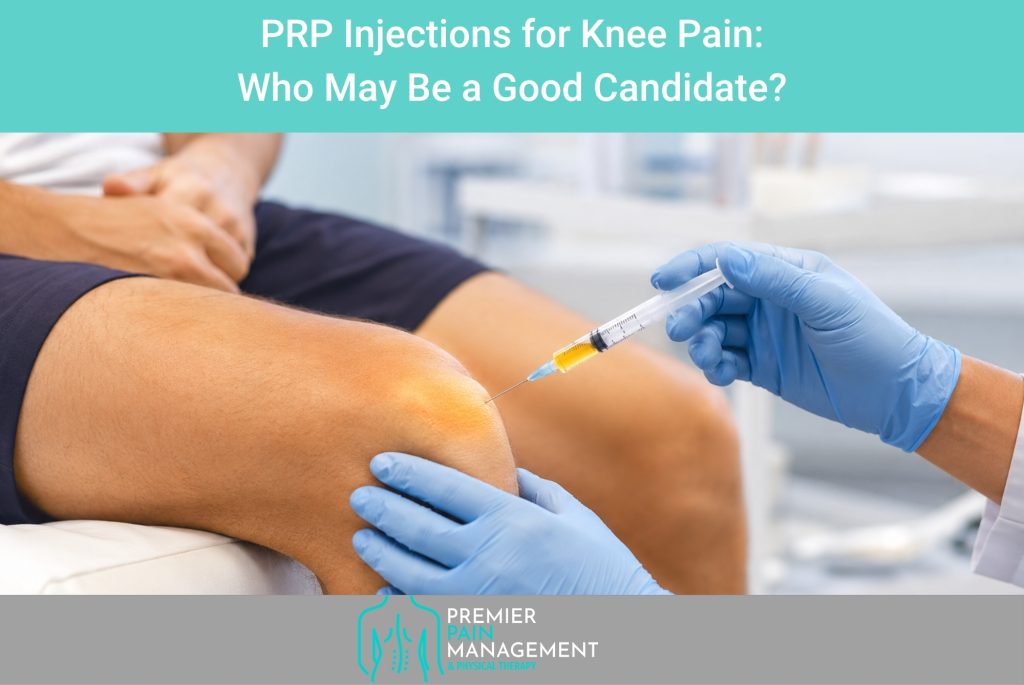
Knee pain can make everyday activities—from walking and climbing stairs to exercising and getting out of a chair—more difficult. For people living with persistent knee pain, particularly pain associated with osteoarthritis or certain musculoskeletal injuries, platelet-rich plasma (PRP) injections may be considered as part of a nonsurgical treatment plan.
PRP therapy uses a concentrated preparation made from a patient’s own blood. The goal is to deliver platelets and platelet-associated growth factors and bioactive molecules to the affected area. In orthopedic medicine, PRP has been studied extensively for knee osteoarthritis and other musculoskeletal conditions. Research suggests that some patients may experience improvements in knee pain, stiffness, and function, although outcomes vary and PRP is not appropriate for every patient.
At Premier Pain Management in Highlands Ranch, Colorado, patients with persistent knee pain can receive a comprehensive evaluation to determine the cause of their symptoms and whether PRP injections or another treatment approach may be appropriate.
What Are PRP Injections?
Understanding Platelet-Rich Plasma
Platelet-rich plasma is prepared from a sample of the patient’s own blood. Blood contains several components, including red blood cells, white blood cells, plasma, and platelets. Platelets are best known for their role in blood clotting, but they also contain growth factors and other biologically active proteins involved in tissue signaling and healing responses.
During PRP preparation, blood is collected and processed to create plasma containing a higher concentration of platelets. The resulting PRP preparation can then be injected into the targeted area.
Because PRP comes from the patient’s own blood, it is considered an autologous treatment.
How PRP Is Used for Knee Pain
When PRP is used for knee osteoarthritis, it is generally injected directly into the knee joint. The objective is not simply to temporarily numb pain. Instead, PRP is intended to influence biological processes within the joint that may contribute to symptoms.
Clinical research has primarily investigated outcomes such as pain, stiffness, physical function, and quality of life.
Importantly, PRP should not be described as a guaranteed method of regenerating knee cartilage. An American Academy of Orthopaedic Surgeons (AAOS) review found improvements in patient-reported symptoms in multiple studies but did not find convincing evidence of increased cartilage thickness in the studies that specifically evaluated structural cartilage changes.
What Types of Knee Pain May Be Treated With PRP?
Knee Osteoarthritis
Knee osteoarthritis is one of the most frequently studied indications for PRP injections.
Osteoarthritis develops as changes occur within cartilage and other structures of the joint. Patients may experience pain, stiffness, swelling, reduced range of motion, and difficulty performing physical activities.
The AAOS states that PRP may reduce pain and improve function in patients with symptomatic knee osteoarthritis, although its recommendation is classified as limited because studies vary considerably in their methods, PRP formulations, and results.
Research has generally suggested that patients with mild-to-moderate osteoarthritis may be among those most likely to benefit. One systematic review concluded that evidence was most supportive for patients with earlier-stage osteoarthritis, although researchers emphasized inconsistencies among available studies.
Degenerative Knee Pain
Not every patient with chronic knee pain has advanced arthritis. Earlier degenerative changes within the joint can also produce pain, stiffness, and activity limitations.
For appropriately selected patients who want to continue conservative treatment before considering surgery, PRP may be discussed alongside options such as physical therapy, exercise modification, medications, and other injection therapies.
Certain Tendon-Related Knee Conditions
PRP is also used in orthopedic and sports medicine for selected tendon and soft-tissue disorders.
Whether PRP is appropriate depends heavily on which structure is injured. Knee pain can originate from cartilage, tendons, ligaments, muscles, bursae, menisci, nerves, or referred pain from another region.
For this reason, identifying the source of knee pain is an important first step before considering PRP.
Who May Be a Good Candidate for PRP Knee Injections?
Patients With Mild-to-Moderate Knee Osteoarthritis
Patients with earlier stages of knee osteoarthritis are frequently considered potential PRP candidates.
Available research suggests PRP outcomes can differ according to arthritis severity. The AAOS has specifically noted variations between early- and late-stage osteoarthritis and emphasizes that additional research is necessary to determine which patient populations benefit most.
Patients With Persistent Knee Pain Despite Conservative Care
PRP may be considered when knee pain continues despite an appropriate trial of conservative treatment.
Depending on the diagnosis, previous treatment may include:
Physical therapy and therapeutic exercise, activity modification, weight management when appropriate, anti-inflammatory or pain-relieving medications, bracing, home exercise programs, and other nonsurgical interventions.
PRP does not necessarily replace these treatments. It may instead become one component of a broader rehabilitation and pain-management strategy.
Active Patients Trying to Maintain Mobility
Persistent knee pain can interfere with recreational activities, exercise, work, and everyday movement.
Some active adults may be interested in PRP because they want to pursue nonsurgical options while maintaining as much mobility as possible.
A physician must still determine whether the underlying condition is suitable for PRP rather than assuming that every type of activity-related knee pain will respond to treatment.
Patients Hoping to Delay More Invasive Treatment
Some patients with osteoarthritis are not ready for joint replacement or do not currently have disease severe enough to warrant surgery.
For selected patients, PRP may be one of several nonsurgical options considered before surgical intervention.
However, PRP cannot guarantee that knee replacement or another procedure will never become necessary.
Who May Not Be an Ideal Candidate for PRP?
Patients With Advanced Structural Joint Damage
PRP is not a substitute for knee replacement when extensive joint destruction has occurred.
Patients with severe osteoarthritis may still be evaluated for PRP, but expectations must be realistic. Evidence concerning PRP in severe knee osteoarthritis has been mixed, and results may differ substantially between patients.
Patients With Knee Pain Requiring Another Treatment
PRP is not appropriate simply because the knee hurts.
For example, some fractures, significant ligament injuries, mechanical joint problems, infections, or advanced degenerative conditions may require different interventions.
Determining the diagnosis is therefore essential before recommending an injection.
Patients With Certain Medical Conditions
A physician should review the patient’s medical history before PRP treatment.
Blood disorders, active infections, certain cancers, significant anemia or platelet abnormalities, medications affecting blood clotting, and other health conditions may influence whether PRP treatment is appropriate.
Patients should provide their physician with a complete list of medications and supplements before treatment. Medications should never be stopped solely in preparation for PRP unless the prescribing or treating clinician specifically recommends doing so.
What Does the Evidence Say About PRP for Knee Osteoarthritis?
Research Shows Potential Benefits but Also Important Limitations
PRP has become one of the most extensively researched biologic injection treatments for knee osteoarthritis.
An AAOS technology review identified multiple clinical trials comparing PRP with saline placebo injections. In general, PRP demonstrated improvements in several patient-reported measures of pain and stiffness. However, researchers also emphasized relatively small patient populations and considerable differences among PRP products and study protocols.
The AAOS clinical practice guideline consequently states that PRP may improve pain and function in symptomatic knee osteoarthritis but assigns the recommendation limited strength because of inconsistent evidence.
More recent research continues to evaluate PRP preparation, platelet concentration, dosing, treatment protocols, and patient selection. A 2025 systematic review and meta-analysis, for example, examined whether the amount of platelets delivered through PRP influences outcomes in patients with mild-to-moderate knee osteoarthritis.
This evolving evidence highlights why individualized evaluation is important.
PRP vs. Cortisone Injections for Knee Pain
The Treatments Work Differently
Corticosteroid injections and PRP injections are fundamentally different treatments.
Corticosteroids are medications intended primarily to reduce inflammation and pain. PRP uses concentrated components of the patient’s own blood and is intended to influence biological processes associated with healing and tissue response.
Neither option is universally superior for every patient.
A clinician may consider factors such as the diagnosis, severity of arthritis, previous treatments, overall health, treatment goals, and expected duration of benefit when recommending an injection.
PRP vs. Hyaluronic Acid Injections
Research Has Compared Both Treatments Extensively
Hyaluronic acid injections are another nonsurgical option sometimes considered for knee osteoarthritis.
AAOS reviewed numerous studies directly comparing PRP and hyaluronic acid. Several studies reported better patient-reported outcomes with PRP, particularly during longer follow-up periods, while other studies found no meaningful difference.
These differences reinforce an important principle: treatment should be selected based on the individual patient rather than assuming one injection is best for everyone.
What Happens During a PRP Knee Injection?
Step 1: Blood Collection
A small amount of the patient’s blood is collected, similar to a routine blood draw.
Step 2: PRP Preparation
The blood is processed so that a platelet-rich portion can be separated and concentrated.
PRP preparation methods vary. Differences in platelet concentration, white blood cell content, processing systems, and injection protocols are among the reasons clinical studies do not always produce identical results.
Step 3: Injection
The prepared PRP is injected into the targeted knee joint or tissue.
The procedure is typically performed in an outpatient setting.
Step 4: Recovery
Patients may experience temporary soreness or discomfort around the injection area. The AAOS identifies temporary local soreness and injection-related pain among possible effects following PRP treatment.
Patients should follow their physician’s specific instructions regarding activity and rehabilitation after the procedure.
How Quickly Does PRP Work for Knee Pain?
Improvement Is Usually Not Immediate
PRP is different from treatments designed primarily to provide rapid temporary pain relief.
When patients respond to PRP, improvements may develop gradually over the following weeks and months.
The timeline varies based on the condition being treated, its severity, the patient’s overall health and activity level, the PRP preparation, and rehabilitation following treatment.
Not everyone experiences significant improvement.
How Many PRP Injections Are Needed?
There is currently no universally accepted PRP injection schedule for knee osteoarthritis.
Clinical studies have investigated single injections as well as multiple-injection protocols. AAOS has reported mixed findings regarding the optimal number of injections and notes that additional research is needed to determine the most effective treatment protocol.
The appropriate treatment plan should therefore be individualized.
Is PRP Safe?
PRP is prepared from the patient’s own blood, which eliminates certain concerns associated with donor-derived biological material.
As with any injection, however, PRP is not risk-free.
Potential effects can include temporary pain, swelling, stiffness, bruising, or soreness at the injection site. Less common complications associated with injections in general can include infection, bleeding, or injury to surrounding structures.
A recent systematic review and meta-analysis has continued to evaluate adverse events associated with intra-articular PRP compared with other knee osteoarthritis injections, reflecting the ongoing effort to better characterize its safety profile.
Why Proper Diagnosis Matters Before PRP Treatment
Knee Pain Is a Symptom, Not a Diagnosis
One of the most important steps in determining PRP candidacy is establishing why the knee hurts.
Two patients can experience nearly identical knee pain while having completely different underlying conditions.
A comprehensive evaluation may include a discussion of symptoms, medical history, physical examination, assessment of knee stability and range of motion, and review of appropriate imaging or previous diagnostic studies.
This allows the treatment plan to address the underlying condition rather than simply the location of the pain.
PRP Should Be Part of a Comprehensive Knee Pain Strategy
Successful knee pain management often requires more than one intervention.
Depending on the patient’s diagnosis, PRP may be combined with rehabilitation, strengthening, flexibility work, activity modification, weight management, biomechanical correction, or other pain-management treatments.
Strengthening the muscles supporting the knee—particularly the quadriceps, hamstrings, hips, and surrounding stabilizing muscles—can be an important component of long-term management for many knee conditions.
The objective is not merely to reduce discomfort temporarily but to improve function and help patients remain active when possible.
Frequently Asked Questions About PRP Injections for Knee Pain
What is PRP for knee pain?
PRP, or platelet-rich plasma, is a preparation made from a patient’s own blood that contains concentrated platelets and associated bioactive molecules. It is injected into targeted tissues or the knee joint as a biologic treatment for selected musculoskeletal conditions.
Is PRP good for knee arthritis?
PRP may help some patients with symptomatic knee osteoarthritis. The AAOS states that PRP may reduce pain and improve function, although the strength of its recommendation remains limited because available studies have produced inconsistent results.
What stage of knee arthritis responds best to PRP?
Evidence has often been more favorable for mild-to-moderate or earlier-stage osteoarthritis than advanced disease. However, arthritis severity alone does not determine candidacy, and individual evaluation remains necessary.
Can PRP regrow cartilage in the knee?
PRP should not be presented as a proven method of regrowing damaged knee cartilage. While studies have demonstrated potential improvements in symptoms, AAOS found no significant cartilage-thickness improvement in one study specifically evaluating that outcome.
Can PRP prevent knee replacement?
PRP cannot guarantee that a patient will avoid knee replacement.
For some patients with earlier-stage disease, PRP may help manage symptoms as part of a nonsurgical treatment strategy. Advanced osteoarthritis may eventually require surgical treatment when conservative therapies no longer provide adequate function or pain control.
Does a PRP knee injection hurt?
Patients generally feel the needle insertion and may experience pressure or discomfort during treatment. Temporary soreness after the injection is also possible.
How long does PRP take to work?
Responses vary. When PRP is effective, improvement generally develops gradually rather than immediately. Patients may notice changes over several weeks, with continued improvement occurring over subsequent months.
How long can PRP relief last?
Duration varies considerably between patients. Clinical studies have evaluated outcomes at six months, nine months, 12 months, and other intervals, but no single duration of benefit applies to every patient.
How many PRP injections will I need?
There is no universal protocol. Some patients receive one injection, while other protocols use a series of injections. Research continues to investigate the ideal number and timing of PRP treatments.
Is PRP better than cortisone for knee pain?
Neither treatment is automatically better for every patient. Corticosteroids and PRP work differently, and the appropriate option depends on the diagnosis, severity of symptoms, medical history, previous treatments, and treatment objectives.
Is PRP better than hyaluronic acid?
Research comparing PRP with hyaluronic acid has produced encouraging but variable results. Some clinical studies have favored PRP for longer-term patient-reported outcomes, while others have found similar results between treatments.
Can athletes receive PRP for knee pain?
Potentially. PRP is used in sports medicine for selected musculoskeletal injuries and degenerative conditions. Athletes should receive a precise diagnosis before treatment because not every ligament, tendon, cartilage, or meniscus injury is appropriately treated with PRP.
Can I exercise after a PRP knee injection?
Patients are generally given specific activity instructions after treatment. Exercise recommendations depend on what is being treated, the injection location, and the patient’s rehabilitation plan. Patients should follow the instructions provided by their treating physician rather than immediately returning to unrestricted exercise.
Are PRP injections covered by insurance?
Coverage varies by insurance company, policy, diagnosis, and treatment circumstances. Patients should verify their individual benefits and expected costs before undergoing treatment.
How do I know if I am a candidate for PRP?
The most reliable way to determine candidacy is through a medical evaluation. A provider can identify the source of the knee pain, evaluate the severity of the condition, review previous treatments and medical history, and discuss whether PRP or another intervention is most appropriate.
When Should You See a Pain Management Specialist for Knee Pain?
Knee pain deserves medical evaluation when it persists, repeatedly returns, interferes with walking or exercise, causes significant stiffness or swelling, limits everyday activities, or does not improve with conservative treatment.
Patients should seek prompt medical attention for severe pain after trauma, inability to bear weight, substantial swelling, obvious deformity, fever associated with a hot or swollen joint, or other rapidly worsening symptoms.
For persistent knee pain, identifying the underlying condition can help determine whether physical therapy, medication, PRP injections, another interventional treatment, or referral for surgical evaluation is appropriate.
Find Out Whether PRP May Be Appropriate for Your Knee Pain
PRP represents a promising nonsurgical treatment option for selected patients with knee pain, particularly certain individuals with symptomatic mild-to-moderate knee osteoarthritis. Current evidence indicates that PRP may improve pain and function, but responses vary, treatment protocols are not standardized, and PRP is not appropriate for every knee condition.
The best candidates are identified through careful diagnosis and individualized treatment planning.
Premier Pain Management provides evaluation and treatment options for patients experiencing persistent knee pain in Highlands Ranch, Colorado. A consultation can help determine the cause of your symptoms and whether PRP injections should be considered as part of your personalized pain-management plan.
Contact Information
Premier Pain Management
8671 S Quebec St. Suite 150
Highlands Ranch, CO 80130
Phone: (303) 683-6868
Website: premierpaingroup.com
Appointments: premierpaingroup.com/appointments/