
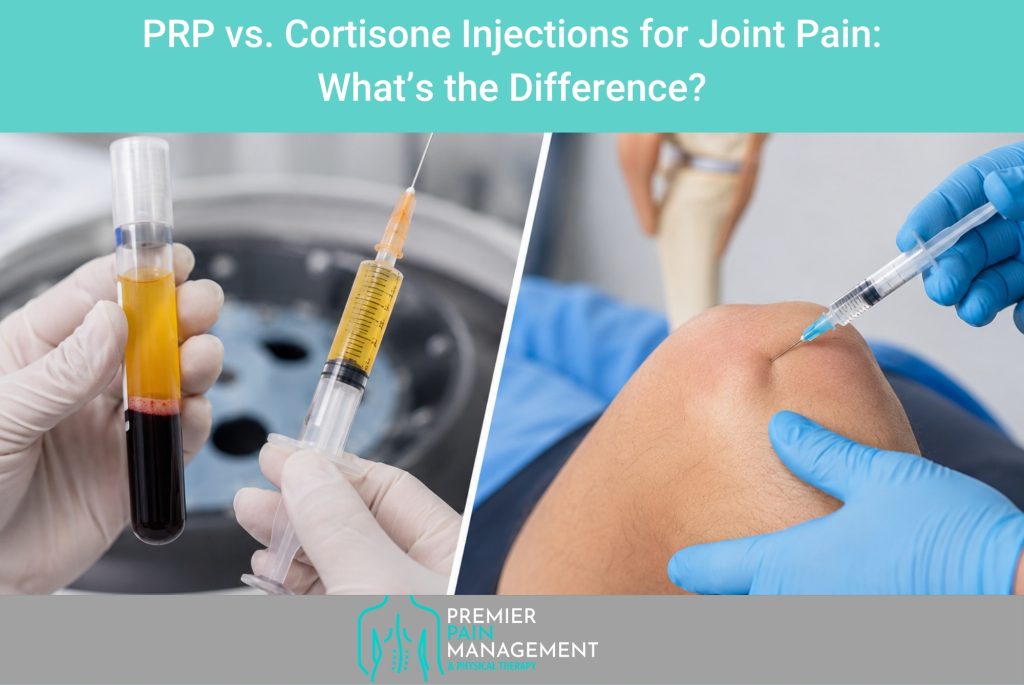
Joint pain can make everyday activities—from walking and exercising to climbing stairs and getting a good night’s sleep—more difficult. When conservative treatments such as activity modification, physical therapy, and medications do not provide adequate relief, injection-based treatments may be considered.
Two commonly discussed options are platelet-rich plasma (PRP) injections and cortisone, or corticosteroid, injections. Although both treatments are administered by injection and may be used for certain painful musculoskeletal conditions, they work in fundamentally different ways.
Cortisone is primarily used to decrease inflammation and provide symptom relief. PRP uses a concentrated preparation derived from the patient’s own blood and is intended to support the body’s biological healing processes.
Understanding the differences between PRP and cortisone injections can help patients have more informed conversations with their healthcare providers about treatment for knee, hip, shoulder, and other joint-related pain.
Understanding the Causes of Joint Pain
Joint pain is a symptom rather than a single medical condition. Determining what is causing the discomfort is an essential first step before choosing an injection or another treatment.
Osteoarthritis
Osteoarthritis is a degenerative joint disease characterized by changes involving cartilage, bone, synovium, and other structures within a joint. It commonly affects the knees, hips, hands, and spine.
Symptoms may include pain, stiffness, swelling, reduced range of motion, and difficulty performing normal activities.
Joint Inflammation
Inflammation within or surrounding a joint can contribute to pain, stiffness, tenderness, and swelling. Inflammation may develop because of arthritis, repetitive stress, injury, or other medical conditions.
Tendon and Soft-Tissue Problems
Not every problem that feels like joint pain originates inside the joint itself. Tendons, bursae, ligaments, and surrounding muscles can also produce symptoms.
Conditions such as tendinopathy and bursitis therefore require an accurate diagnosis before an injection is recommended.
Sports and Overuse Injuries
Repetitive movements, athletic activity, and sudden injuries can affect the tissues surrounding a joint. The appropriate treatment depends on the injured structure, severity of the injury, symptoms, activity level, and overall health of the patient.
What Are Cortisone Injections?
Cortisone injections contain corticosteroid medication. Corticosteroids are powerful anti-inflammatory medications that can be injected directly into or around an affected joint or painful structure.
Their primary purpose is to decrease inflammation and associated pain.
How Cortisone Works
Inflammation is part of the body’s normal response to tissue irritation or injury. However, excessive or persistent inflammation can contribute to ongoing discomfort.
Corticosteroids influence several inflammatory pathways and can suppress the inflammatory response. When injected into an affected area, the medication may reduce inflammation locally and provide temporary symptom relief.
How Quickly Do Cortisone Injections Work?
Response times vary. Some patients experience improvement within several days, while others may need longer.
The amount and duration of relief also differ substantially among patients. The underlying diagnosis, severity of the condition, injection location, medication used, and individual response can all affect results.
How Long Does a Cortisone Injection Last?
Cortisone injections are generally considered a short-term symptom-management strategy rather than a permanent solution.
For knee osteoarthritis specifically, the American Academy of Orthopaedic Surgeons (AAOS) states that intra-articular corticosteroids may provide short-term relief.
Some patients experience meaningful relief for weeks or months, while others receive little improvement.
What Is Platelet-Rich Plasma Therapy?
Platelet-rich plasma therapy is an autologous treatment, meaning the material used for treatment comes from the patient’s own body.
A small amount of blood is collected and processed to create plasma containing a concentrated amount of platelets. The resulting PRP preparation is then injected into the targeted area.
Why Are Platelets Important?
Platelets are best known for their role in blood clotting, but they also contain signaling proteins and growth factors involved in biological processes associated with tissue repair.
PRP therapy attempts to concentrate these components and deliver them to an injured or degenerative area.
How Is PRP Prepared?
PRP treatment generally begins with a standard blood draw.
The blood is placed into specialized processing equipment, commonly a centrifuge, that separates its components according to density. The platelet-containing portion is then prepared for injection.
Importantly, there is no single universal PRP formulation. Platelet concentration, leukocyte concentration, processing systems, injection protocols, and other characteristics can vary.
This variability is one reason results between PRP studies are not always identical. Current AAOS guidance describes the evidence supporting PRP for symptomatic knee osteoarthritis as limited and notes inconsistencies within the available research.
PRP vs. Cortisone: How Do They Work Differently?
The most important distinction between PRP and cortisone is their therapeutic objective.
Cortisone Primarily Suppresses Inflammation
Cortisone is designed to decrease inflammatory activity. This can make it particularly useful when inflammation is an important contributor to pain.
The objective is primarily symptom reduction rather than stimulation of tissue regeneration.
PRP Uses the Patient’s Own Platelets
PRP takes a different biological approach. Instead of administering a corticosteroid, clinicians concentrate platelets from the patient’s blood and inject the resulting preparation into the treatment area.
PRP is intended to influence the biological environment associated with healing and tissue response.
PRP should not, however, be described as a proven way to regrow cartilage or permanently reverse arthritis. Evidence varies considerably by condition and treatment protocol.
PRP vs. Cortisone for Knee Osteoarthritis
Knee osteoarthritis is one of the areas in which PRP and corticosteroid injections have been extensively compared.
A 2024 systematic review and meta-analysis involving 35 randomized controlled trials and 3,348 patients found that corticosteroid injections produced results comparable to PRP at short-term follow-up, while PRP demonstrated better outcomes at longer follow-up periods in the included knee osteoarthritis studies.
Another systematic review and meta-analysis evaluating 21 randomized controlled trials and 2,406 participants found improvements in pain and function favoring intra-articular PRP over corticosteroid injections for knee osteoarthritis, although researchers continue to emphasize variability among PRP preparations and study protocols.
These findings do not mean that PRP is automatically the better treatment for every patient. Treatment decisions should consider the diagnosis, severity of osteoarthritis, previous treatments, health history, treatment objectives, cost, and available evidence.
PRP vs. Cortisone: How Fast Does Each Treatment Work?
Patients often focus on how quickly an injection can relieve pain.
Cortisone May Provide Faster Symptom Relief
Because corticosteroids directly suppress inflammation, they may provide relatively rapid improvement when inflammation is a major source of symptoms.
This can make cortisone useful when short-term symptom control is a treatment priority.
PRP Improvement May Be More Gradual
PRP generally is not intended to act as an immediate anesthetic or powerful anti-inflammatory medication.
When patients respond to PRP, improvement may occur gradually over the weeks and months following treatment.
Research comparing the treatments for knee osteoarthritis has suggested that the difference may become more apparent at intermediate and longer follow-up periods, with PRP producing better outcomes in some studies.
Which Treatment Lasts Longer?
Neither treatment has a guaranteed duration of effectiveness.
Cortisone commonly provides temporary relief. PRP studies examining knee osteoarthritis have reported improvements extending for several months in some patients.
However, results should not be generalized to every joint or condition.
PRP research varies according to preparation method, injection schedule, condition being treated, disease severity, and outcome measurement. Long-term evidence is still developing, and AAOS notes that additional research is needed to compare PRP and corticosteroid injections over periods such as two to five years.
Does PRP Regrow Cartilage?
Claims that PRP routinely regrows damaged cartilage should be approached cautiously.
Current clinical evidence supports discussing PRP primarily in terms of potential improvements in pain and function for selected conditions rather than promising structural regeneration.
For symptomatic knee osteoarthritis, AAOS states that PRP may reduce pain and improve function, but the strength of its recommendation remains limited because of inconsistent evidence.
Patients should therefore be cautious about claims promising that PRP can rebuild an arthritic joint or eliminate the need for future treatment.
Are PRP Injections FDA-Approved for Joint Pain?
Patients should understand the regulatory status of regenerative medicine treatments.
The U.S. Food and Drug Administration states that regenerative medicine therapies have not been approved for the treatment of orthopedic conditions such as osteoarthritis, tendonitis, back pain, hip pain, knee pain, neck pain, or shoulder pain.
This does not mean PRP cannot be offered in clinical practice. Rather, patients should understand the distinction between clinical use and FDA approval and discuss the evidence, risks, potential benefits, and alternatives with a qualified healthcare professional.
What Are the Potential Benefits of Cortisone Injections?
Corticosteroid injections remain widely used because they may provide meaningful symptom relief for appropriately selected patients.
Potential advantages include relatively rapid reduction of inflammation, short-term pain relief, improved mobility, and the ability to target medication directly to a symptomatic area.
For some patients, reducing pain temporarily can also make participation in physical therapy or therapeutic exercise easier.
What Are the Potential Benefits of PRP?
PRP has several characteristics that make it attractive to appropriately selected patients.
Because PRP is prepared from the patient’s own blood, the treatment does not depend on corticosteroid medication. Research suggests that PRP may improve pain and function in some patients with knee osteoarthritis, particularly over intermediate follow-up periods.
PRP may therefore be considered as part of a broader nonsurgical treatment strategy when clinically appropriate.
What Are the Risks of Cortisone Injections?
Cortisone injections are medical procedures and are not risk-free.
Potential risks can include temporary pain after injection, infection, bleeding, changes in skin pigmentation, temporary increases in blood glucose, and other medication- or procedure-related complications.
Repeated corticosteroid exposure can also raise additional concerns depending on the joint, dose, frequency, and patient’s health.
For this reason, cortisone injections should be used according to an individualized treatment plan rather than simply repeated whenever pain returns.
What Are the Risks of PRP Injections?
Because PRP is obtained from the patient’s own blood, allergic reactions to the injected biological material are generally less of a concern than with medications derived from outside sources.
However, the injection procedure itself still carries potential risks.
Patients may experience temporary pain, swelling, stiffness, bruising, bleeding, or soreness after treatment. Infection is uncommon but remains a potential complication of any procedure involving an injection.
AAOS specifically notes that temporary local soreness or injection pain may occur following PRP treatment.
Who May Be a Candidate for Cortisone?
Cortisone may be considered when inflammation is contributing significantly to pain and short-term symptom control is a primary objective.
A clinician should evaluate the patient’s diagnosis, medical history, previous injections, medications, diabetes status, infection risk, and other factors before recommending treatment.
Who May Be a Candidate for PRP?
PRP may be considered for selected patients with certain musculoskeletal conditions who continue to experience symptoms despite conservative treatment.
For knee osteoarthritis, evidence suggests that some patients with symptomatic disease may experience improvements in pain and function.
PRP candidacy should nevertheless be determined individually. The severity of joint degeneration, overall health, medications, expectations, and previous treatments may all influence the decision.
Can PRP and Cortisone Replace Physical Therapy?
Injection treatments should not necessarily be viewed as substitutes for rehabilitation.
Joint pain frequently benefits from a comprehensive approach that may include physical therapy, therapeutic exercise, strengthening, mobility training, activity modification, weight management when appropriate, and treatment of biomechanical problems.
An injection may reduce symptoms enough for a patient to participate more effectively in rehabilitation, but improving strength, flexibility, and movement patterns can remain important for long-term function.
PRP vs. Cortisone: Which Is Better?
There is no universally superior injection for every patient or every joint condition.
Cortisone may be appropriate when rapid, short-term reduction of inflammation is the primary objective.
PRP may be considered when a patient and clinician are interested in a biologic treatment using the patient’s own platelets and the patient’s diagnosis is supported by reasonable clinical evidence.
For knee osteoarthritis specifically, several systematic reviews suggest PRP may provide better intermediate- and longer-term improvements than corticosteroid injections for some patients. However, evidence remains heterogeneous, and AAOS continues to characterize its PRP recommendation as limited.
The most appropriate choice depends on the diagnosis—not simply which injection is newer or provides the fastest relief.
Why an Accurate Diagnosis Matters Before an Injection
Pain around the knee, hip, shoulder, or another joint can originate from several different structures.
For example, knee pain could arise from osteoarthritis, meniscus pathology, ligament injury, tendon problems, bursitis, referred pain, or another condition.
Treating every type of joint pain with the same injection is therefore unlikely to produce optimal results.
A thorough medical evaluation can help determine what structure is generating symptoms and whether PRP, cortisone, physical therapy, medication, another minimally invasive procedure, or a different treatment strategy is appropriate.
A Comprehensive Approach to Joint Pain at Premier Pain Management
At Premier Pain Management in Highlands Ranch, Colorado, evaluating joint pain begins with identifying the underlying source of symptoms.
Treatment recommendations can then be tailored to the patient’s condition, health history, activity level, functional limitations, and goals.
For some patients, an injection may be one component of treatment rather than the entire treatment plan. Combining appropriate pain management with rehabilitation, strengthening, and lifestyle strategies may provide a more comprehensive approach to maintaining mobility and function.
Frequently Asked Questions About PRP vs. Cortisone Injections
What is the main difference between PRP and cortisone?
Cortisone is a corticosteroid medication primarily used to suppress inflammation and reduce symptoms. PRP is prepared from the patient’s own blood and contains concentrated platelets intended to influence biological processes associated with healing and tissue response.
Is PRP better than cortisone for arthritis?
It depends on the type of arthritis and the individual patient. For knee osteoarthritis, systematic reviews have found that PRP can provide better intermediate- and longer-term pain and functional outcomes than corticosteroid injections in some patients. However, PRP evidence remains variable, and it should not be considered universally superior for every patient or every form of arthritis.
Does cortisone work faster than PRP?
Cortisone often provides faster symptom relief because corticosteroids directly reduce inflammation. PRP-related improvement, when it occurs, is generally expected to develop more gradually.
How long does PRP take to work?
There is no universal timeline. Some patients notice gradual changes within several weeks, while improvement may continue over subsequent months. Results vary according to the condition, PRP formulation, treatment protocol, and individual patient factors.
How long does a cortisone injection last?
Relief varies substantially. Some patients experience improvement for several weeks or months, while others receive minimal benefit. Cortisone is generally used for short-term symptom management.
Can PRP permanently cure arthritis?
No. PRP should not be presented as a permanent cure for osteoarthritis. It may improve pain and function for selected patients, but it has not been proven to reliably reverse the underlying degenerative process.
Can PRP regrow cartilage?
Current evidence does not support guaranteeing cartilage regrowth after PRP. Research continues to investigate PRP’s effects on joint biology, but clinical treatment should focus on realistic goals such as reducing pain and improving function.
How many PRP injections are needed?
Protocols vary. Some clinicians use a single injection, while others use a series. The optimal number depends on the condition, PRP preparation, clinical protocol, and individual response.
Can you get PRP after previously having cortisone injections?
Previous cortisone treatment does not automatically prevent someone from receiving PRP. However, the timing and appropriateness of treatment should be determined by the treating healthcare provider based on medical history and clinical circumstances.
Is PRP painful?
Patients may feel discomfort during the injection and temporary soreness afterward. AAOS notes that temporary local soreness or injection pain may occur following PRP.
Can cortisone injections be repeated?
Corticosteroid injections can sometimes be repeated, but the frequency and total number should be determined by a healthcare provider. Repeated injections are not automatically appropriate simply because an earlier injection helped.
Is PRP FDA-approved for osteoarthritis?
The FDA states that regenerative medicine therapies have not been approved for orthopedic conditions such as osteoarthritis and knee pain. Patients considering PRP should discuss its regulatory status, evidence, benefits, limitations, and risks with their healthcare provider.
Does insurance cover PRP injections?
Coverage varies by insurance plan and indication. PRP is frequently considered investigational by insurers and may require out-of-pocket payment. Patients should verify coverage directly with their insurance carrier and treatment provider.
Which injection should I choose for joint pain?
The decision should be based on the cause of the pain, severity of the condition, previous treatments, medical history, treatment goals, and current scientific evidence. A clinical evaluation is the best way to determine whether PRP, cortisone, or another treatment is appropriate.
Making an Informed Decision About Joint Pain Treatment
PRP and cortisone injections represent two distinctly different approaches to managing joint pain.
Cortisone focuses primarily on suppressing inflammation and may provide relatively rapid, short-term symptom relief. PRP uses concentrated platelets derived from the patient’s own blood and is intended to support biological processes associated with healing. For knee osteoarthritis, recent systematic reviews have reported longer-lasting improvements with PRP compared with corticosteroids in some patient populations, although the quality and consistency of evidence remain important considerations.
Neither injection is appropriate for every patient, and neither should be viewed as a guaranteed cure for chronic joint disease.
At Premier Pain Management, patients experiencing persistent joint pain can receive an individualized evaluation to determine the underlying cause of their symptoms and discuss evidence-based treatment options designed to reduce pain, restore mobility, and support long-term function.
Contact Information
Premier Pain Management
8671 S Quebec St. Suite 150
Highlands Ranch, CO 80130
Phone: (303) 683-6868
Website: premierpaingroup.com
Appointments: premierpaingroup.com/appointments/