
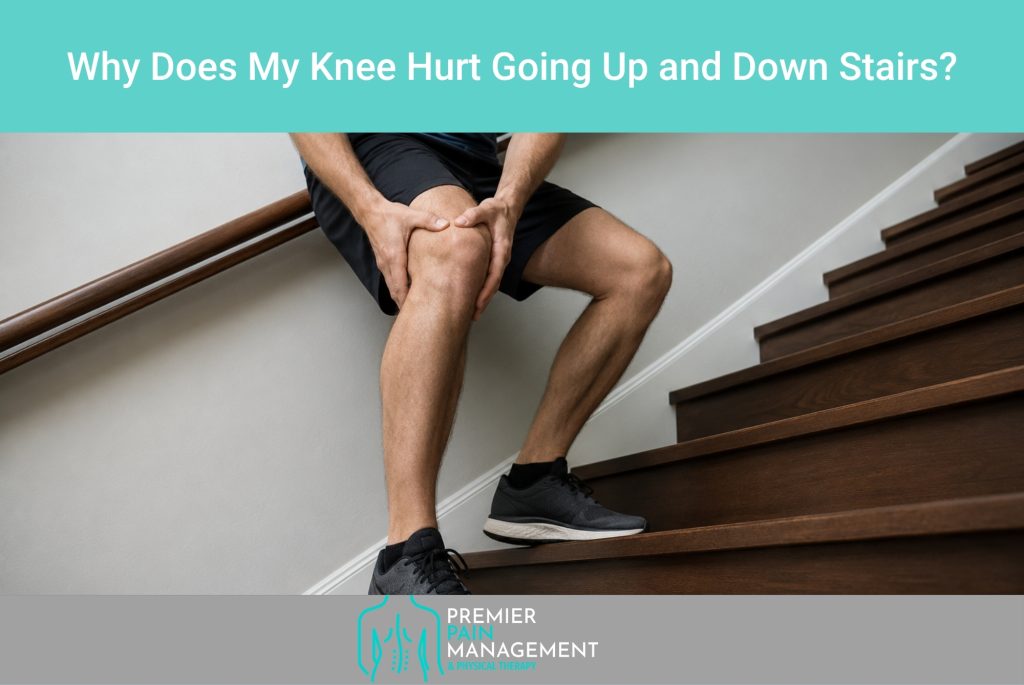
Knee pain while climbing or descending stairs is a common problem that can affect people of many ages and activity levels. You may feel perfectly comfortable sitting at a desk or walking across a flat surface, only to notice aching, pressure, stiffness, or a sharp sensation as soon as you encounter a staircase.
The reason often comes down to biomechanics. Going up and down stairs requires the knee to bend while supporting and controlling a substantial portion of your body weight. This increases the forces transmitted through the knee joint, particularly around the kneecap. When cartilage, tendons, muscles, ligaments, or other structures are irritated, stair climbing can make the problem much more noticeable.
At Premier Pain Management in Highlands Ranch, Colorado, evaluating knee pain involves identifying its underlying source rather than focusing only on the symptom. Understanding why your knee hurts on stairs can help determine which conservative or minimally invasive treatment options may be appropriate.
Why Stairs Put More Stress on Your Knees
Walking on level ground and navigating stairs are biomechanically different activities. During stair climbing, the knee bends more deeply, and the quadriceps muscles must generate greater force to raise or lower the body.
The Role of the Patellofemoral Joint
The patella, commonly called the kneecap, sits at the front of the knee and moves within a groove at the end of the femur. Together, these structures form the patellofemoral joint.
As the knee bends, the patella interacts more closely with the femur. The forces across this joint increase during activities such as stair climbing, squatting, lunging, and rising from a chair.
If the cartilage or surrounding tissues are irritated, these increased forces can produce pain around or behind the kneecap.
Why Going Down Stairs May Hurt More
Some people find descending stairs considerably more painful than climbing them. When you walk downstairs, your quadriceps muscles work eccentrically, meaning they lengthen while contracting to control your body’s downward movement.
The knee therefore acts partly as a shock absorber and braking mechanism. Conditions affecting the kneecap, cartilage, tendons, or overall knee mechanics may become particularly noticeable during this controlled lowering movement.
Common Causes of Knee Pain When Using Stairs
Several conditions can cause knee pain when going up or down stairs. The location of the pain, when it occurs, associated symptoms, previous injuries, age, and activity level can all provide important diagnostic clues.
Patellofemoral Pain Syndrome
Patellofemoral pain syndrome is a frequent cause of pain around or behind the kneecap. It is sometimes referred to as “runner’s knee,” although runners are far from the only people who develop it.
Symptoms can become more noticeable during activities that repeatedly load a bent knee, including:
Stair climbing, squatting, running, jumping, kneeling, and sitting with the knees bent for extended periods.
Muscle weakness, overuse, training changes, lower-extremity biomechanics, and altered movement patterns may contribute to patellofemoral symptoms.
Knee Osteoarthritis
Osteoarthritis occurs when changes develop within the joint’s cartilage and other tissues. Although osteoarthritis becomes more common with age, symptoms and severity vary considerably from one person to another.
Common symptoms can include knee pain, stiffness, swelling, reduced flexibility, tenderness, and difficulty performing weight-bearing activities.
Because stairs place additional demand on the knee, osteoarthritis symptoms may become noticeable during stair climbing before they substantially interfere with easier activities.
Chondromalacia Patella
Chondromalacia patella refers to changes involving the cartilage on the underside of the kneecap. It can cause discomfort at the front of the knee, particularly during activities involving repeated knee bending.
Patients may notice aching or grinding sensations when climbing stairs, squatting, kneeling, or standing after prolonged sitting.
Patellar Tendinopathy
The patellar tendon connects the kneecap to the tibia. Repetitive loading can irritate or cause degenerative changes within this tendon, producing a condition often called patellar tendinopathy or “jumper’s knee.”
Pain is commonly located just below the kneecap and may worsen with jumping, running, stairs, or other activities that require forceful quadriceps contraction.
Quadriceps Tendon Problems
The quadriceps tendon connects the quadriceps muscles to the kneecap. Irritation or injury to this tendon may cause pain above the kneecap.
Stairs can aggravate the condition because the quadriceps play an essential role in controlling knee movement.
Meniscus Injuries
The menisci are crescent-shaped structures that help distribute forces across the knee and contribute to joint stability.
A meniscus injury can occur suddenly during twisting or pivoting, or degenerative changes can develop gradually. Depending on the injury, symptoms may include pain along the joint line, swelling, catching, clicking, restricted motion, or sensations of the knee giving way.
Bursitis
Small fluid-filled sacs called bursae reduce friction around joints. Inflammation of a knee bursa can produce localized pain, tenderness, and swelling.
Symptoms may become worse with repetitive activity, kneeling, or bending the knee.
Previous Knee Injuries
An old ligament, cartilage, tendon, or meniscus injury can change knee mechanics even after the initial injury has healed.
Some people therefore begin experiencing pain during stairs months or years after an earlier sports injury, fall, collision, or other trauma.
Does the Location of Knee Pain Matter?
Yes. The exact location of pain can help a healthcare provider narrow down possible causes, although location alone cannot establish a diagnosis.
Pain in the Front of the Knee
Pain around or behind the kneecap may be associated with patellofemoral pain, cartilage irritation, patellar tendinopathy, or other anterior knee conditions.
Pain on the Inside of the Knee
Medial knee pain can potentially involve the medial meniscus, osteoarthritis, ligaments, tendons, or nearby bursae.
Pain on the Outside of the Knee
Lateral knee pain can originate from structures including the lateral meniscus, ligaments, tendons, or iliotibial band.
Pain Behind the Knee
Posterior knee pain has several possible causes and deserves appropriate evaluation, particularly if accompanied by significant swelling or other unusual symptoms.
What Do Different Knee Symptoms Mean?
Knee pain does not always occur by itself. Additional symptoms can provide useful information about what may be happening within the joint.
Clicking or Popping
Knees can make sounds without anything being seriously wrong. However, painful clicking, popping, catching, or locking warrants greater attention, particularly following an injury.
Grinding or Crunching
A grinding or crunching sensation is sometimes called crepitus. It can occur with patellofemoral conditions and osteoarthritis, although crepitus alone does not necessarily indicate significant joint damage.
Swelling
Swelling may indicate inflammation or fluid accumulation within or around the knee. Significant swelling after an injury should be professionally evaluated.
Buckling or Giving Way
A knee that repeatedly gives way can be associated with pain-related muscle inhibition, weakness, ligament instability, or other mechanical problems.
Stiffness
Stiffness can occur with arthritis, inflammation, injury, or reduced joint mobility. When stiffness becomes persistent or progressively worsens, evaluation can help identify its cause.
Why Knee Pain Should Be Properly Diagnosed
“Knee pain” describes a symptom, not a diagnosis. Two people with nearly identical symptoms while climbing stairs may have very different underlying conditions.
An appropriate evaluation may include a detailed medical history, discussion of previous injuries, assessment of pain patterns, physical examination, strength and mobility testing, and evaluation of how the knee moves during functional activities.
When clinically appropriate, imaging or additional diagnostic testing may be recommended.
Identifying the source of the problem helps avoid a one-size-fits-all approach to treatment.
How Is Knee Pain From Stairs Treated?
Treatment depends on the diagnosis, severity of symptoms, activity level, medical history, and individual goals. Many knee conditions can initially be managed without surgery.
Activity Modification
Temporary changes to activities that repeatedly aggravate the knee can allow irritated tissues to settle.
This does not necessarily mean avoiding movement entirely. Instead, a provider may recommend modifying specific movements, exercise intensity, training volume, or other activities while addressing the underlying problem.
Physical Therapy and Therapeutic Exercise
Physical therapy can be an important part of treatment for many causes of knee pain.
A rehabilitation program may focus on improving quadriceps and hip strength, flexibility, joint mobility, balance, movement control, and functional mechanics.
Treatment should be individualized because exercises that are beneficial for one knee condition may not be appropriate for another.
Improving Hip and Leg Strength
The knee functions as part of a larger kinetic chain that includes the hips, pelvis, ankles, and feet.
Weakness or poor control elsewhere in the lower extremity can alter the forces passing through the knee. Strengthening appropriate muscle groups may therefore help improve knee mechanics and functional tolerance.
Medications
Depending on a patient’s health and diagnosis, a clinician may recommend certain medications to help manage pain or inflammation.
Medication should be used according to professional guidance, particularly for patients with other medical conditions or those taking additional medications.
Knee Injections
For selected patients, injections may be considered when conservative measures have not provided sufficient improvement or when additional symptom control is needed.
The appropriate injection depends on the diagnosis and individual circumstances.
Corticosteroid Injections
Corticosteroid injections may provide temporary relief from pain and inflammation in certain knee conditions, particularly inflammatory arthritis symptoms.
Because corticosteroids do not correct every cause of knee pain and repeated use has limitations, the potential benefits and risks should be discussed with a qualified provider.
Hyaluronic Acid Injections
Hyaluronic acid injections are sometimes considered for patients with symptomatic knee osteoarthritis. Response varies among individuals, and clinical recommendations depend on the patient’s condition and treatment history.
Platelet-Rich Plasma (PRP)
PRP involves concentrating platelets from a patient’s own blood and injecting the preparation into a targeted area.
PRP has been investigated for conditions including knee osteoarthritis and certain tendon disorders. Research continues to evaluate which patients are most likely to benefit, optimal preparation techniques, and long-term outcomes.
A consultation is necessary to determine whether PRP is appropriate for a particular knee problem.
Can Knee Pain From Stairs Improve Without Surgery?
Many causes of knee pain can be treated conservatively, particularly when diagnosed early and appropriately managed.
A treatment plan may combine rehabilitation, activity modification, strengthening, weight management when appropriate, medications, and minimally invasive treatments.
Surgery may be considered for certain severe structural injuries, advanced joint disease, or persistent symptoms that have not responded adequately to appropriate nonsurgical care. However, experiencing pain on stairs does not automatically mean surgery will be necessary.
Should You Stop Using Stairs if Your Knee Hurts?
Not necessarily.
Mild discomfort does not always mean that stairs are damaging your knee. However, repeatedly pushing through significant or worsening pain is also not an ideal strategy.
Until you know what is causing your symptoms, reducing unnecessary stair use or modifying aggravating activities may be reasonable. A healthcare professional can help determine which activities are safe and which should temporarily be limited.
When Should You See a Pain Management Specialist?
Occasional mild knee soreness after unusual activity may resolve on its own. Persistent or recurrent pain deserves closer attention.
Consider scheduling an evaluation if knee pain:
Persists or progressively worsens, regularly interferes with stairs or everyday activities, causes significant stiffness or swelling, limits walking or exercise, repeatedly wakes you at night, follows an injury, or is associated with instability, locking, or reduced range of motion.
Earlier evaluation can help determine the cause and establish an appropriate treatment strategy before pain increasingly limits daily activities.
When Is Knee Pain an Emergency?
Most knee pain does not require emergency treatment, but certain symptoms warrant prompt medical attention.
Seek urgent medical care for severe pain following major trauma, an obvious deformity, inability to bear weight after an acute injury, rapidly increasing swelling, or a knee that becomes markedly red, hot, and swollen, particularly when accompanied by fever or illness.
New calf swelling, warmth, or pain—especially with chest pain or shortness of breath—also requires immediate medical assessment because these symptoms can potentially indicate a blood clot or related complication.
Preventing Knee Pain When Climbing Stairs
Not every knee problem can be prevented, but maintaining lower-extremity strength and healthy movement patterns can support knee function.
Build Strength Gradually
Sudden increases in running, hiking, squatting, jumping, or stair-based exercise can overload tissues that have not had sufficient time to adapt.
Progressively increasing activity allows muscles, tendons, and joints to accommodate greater demands.
Maintain Hip and Quadriceps Strength
Strong quadriceps help control the knee, while hip muscles contribute to alignment and stability throughout the lower extremity.
A properly designed strengthening program can improve the body’s ability to manage forces during stairs and other everyday activities.
Pay Attention to Persistent Symptoms
Pain is information. Recurrent knee discomfort during the same activity may indicate that something needs to be addressed.
Rather than repeatedly working through worsening symptoms, consider having the knee evaluated.
Frequently Asked Questions About Knee Pain on Stairs
Why does my knee hurt when going downstairs but not when walking?
Descending stairs requires greater knee flexion and controlled muscle activity compared with level walking. This can increase forces around the kneecap and other knee structures. Patellofemoral pain and other conditions may therefore become noticeable on stairs even when normal walking remains comfortable.
Why does my knee hurt going upstairs?
Climbing stairs requires substantial work from the quadriceps and increases loading across the knee. Pain may be related to patellofemoral problems, arthritis, tendon irritation, previous injury, or another musculoskeletal condition.
Why does the front of my knee hurt on stairs?
Pain at the front of the knee is frequently associated with the patellofemoral joint, although tendons and other structures can also cause anterior knee pain. A physical examination can help distinguish among potential causes.
Does knee pain on stairs mean I have arthritis?
No. Osteoarthritis is one possible cause, but patellofemoral pain, tendinopathy, cartilage problems, meniscus injuries, muscle weakness, and other conditions can also cause stair-related knee pain.
Can young adults have knee pain on stairs?
Yes. Younger people can experience patellofemoral pain, sports injuries, tendon problems, overuse conditions, or biomechanical issues. Knee pain should not automatically be attributed to aging.
Is knee clicking on stairs normal?
Painless clicking or popping can occur in healthy knees. Clicking accompanied by pain, swelling, locking, instability, or a recent injury should be evaluated.
What does it mean if my knee feels like it will give out on stairs?
Giving way can have several causes, including pain, muscle weakness, ligament instability, or other mechanical problems. Repeated buckling deserves medical evaluation because it can also increase the risk of falling.
Should I exercise if my knee hurts?
Appropriate movement is often beneficial, but the correct type and intensity depend on the cause of your pain. Rather than assuming all exercise is either good or harmful, an individualized evaluation can identify activities that are appropriate for your condition.
Are squats bad for painful knees?
Not inherently. Squatting is a normal movement, but depth, technique, resistance, and the underlying knee condition affect how well it is tolerated. Modified squats may sometimes be incorporated into rehabilitation under professional guidance.
Can physical therapy help knee pain on stairs?
Physical therapy may help many patients by addressing strength, flexibility, movement mechanics, and functional control. Its effectiveness depends on the underlying diagnosis and an appropriately designed rehabilitation plan.
Can injections help knee pain?
For selected conditions and patients, injections may be incorporated into a broader treatment plan. Options can include corticosteroid, hyaluronic acid, or PRP injections depending on the diagnosis. An evaluation is necessary to determine whether an injection is appropriate and which type should be considered.
Can losing weight reduce knee pain?
For individuals who are overweight or obese, weight reduction may decrease mechanical loading across weight-bearing joints and can be an important component of osteoarthritis management. Weight management is only one factor, however, and knee pain can occur at any body weight.
Will a knee brace help when using stairs?
A brace may benefit certain patients depending on the underlying condition, but braces are not universally necessary. Proper diagnosis can help determine whether bracing is likely to provide meaningful support.
When should I worry about knee pain?
Seek evaluation when pain is persistent, worsening, recurrent, associated with substantial swelling or instability, or interferes with everyday activities. Severe symptoms after trauma or signs of infection require more urgent assessment.
Will I need surgery if stairs hurt my knees?
Usually, stair-related pain alone does not mean surgery is necessary. Many knee conditions respond to conservative or minimally invasive treatment. Surgery is generally reserved for specific structural problems or circumstances in which appropriate nonsurgical treatment has not provided sufficient improvement.
Getting to the Source of Knee Pain
Pain when going up or down stairs can provide an important clue about how your knee responds to increased mechanical demand. While patellofemoral pain and osteoarthritis are common possibilities, tendon disorders, meniscus problems, previous injuries, muscle weakness, and other conditions can produce similar symptoms.
The key is determining why your particular knee hurts.
Premier Pain Management in Highlands Ranch, Colorado, can evaluate persistent knee pain and develop an individualized treatment strategy based on the underlying condition. Depending on your diagnosis, treatment may include conservative therapies, rehabilitation, medication management, or minimally invasive procedures designed to improve function and help you return to everyday activities with greater comfort.
Contact Information
Premier Pain Management
8671 S Quebec St. Suite 150
Highlands Ranch, CO 80130
Phone: (303) 683-6868
Website: premierpaingroup.com
Appointments: premierpaingroup.com/appointments/