
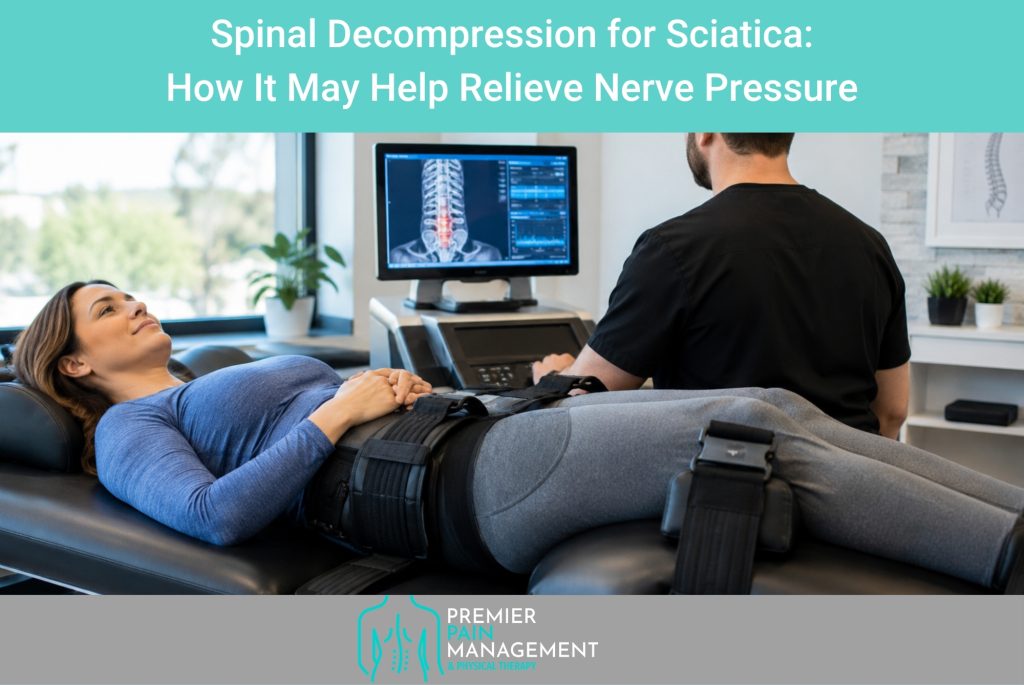
Sciatica can turn ordinary activities such as sitting, walking, driving, exercising, or sleeping into uncomfortable experiences. The pain may begin in the lower back and travel through the buttock and down the leg, sometimes accompanied by numbness, tingling, burning sensations, or weakness. Because sciatica involves irritation or compression of the sciatic nerve or its contributing nerve roots, effective treatment often focuses on addressing the underlying source of nerve pressure rather than simply masking symptoms.
At Premier Pain Management in Highlands Ranch, Colorado, patients experiencing sciatica and other types of back and leg pain can receive an individualized evaluation to determine the cause of their symptoms and appropriate treatment options. For some patients, spinal decompression may be considered as part of a conservative approach to reducing pressure on irritated spinal structures and improving function.
What Is Sciatica?
Understanding the Sciatic Nerve
The sciatic nerve is the largest nerve in the human body. It originates from nerve roots in the lower spine and travels through the buttocks before extending down the legs.
Sciatica is not a disease itself. Instead, it describes symptoms that develop when the sciatic nerve or one of the nerve roots contributing to it becomes irritated, inflamed, or compressed.
Symptoms typically affect one side of the body, although the location and severity can vary depending on which nerve root is involved and what is causing the irritation.
What Does Sciatica Feel Like?
Sciatica symptoms can range from mild and intermittent to severe and persistent. Patients may experience:
- Lower back pain
- Buttock pain
- Pain traveling down the back or side of the thigh
- Pain extending into the calf or foot
- Burning or electric-shock-like sensations
- Tingling or “pins and needles”
- Numbness
- Muscle weakness
- Increased discomfort while sitting
- Pain triggered by coughing or sneezing
Some people primarily experience leg pain rather than significant lower back pain.
What Causes Sciatic Nerve Pressure?
Herniated or Bulging Discs
Intervertebral discs provide cushioning between the vertebrae. When a disc bulges or herniates, displaced disc material may irritate or compress a nearby spinal nerve root.
Lumbar disc herniation is one of the most recognized causes of sciatica.
Degenerative Disc Changes
Spinal discs can gradually lose hydration, elasticity, and height with age. These degenerative changes may alter the space available for spinal nerves and contribute to nerve irritation.
Spinal Stenosis
Lumbar spinal stenosis occurs when spaces within the lower spine become narrowed. This narrowing can place pressure on spinal nerves and may cause pain, numbness, weakness, or heaviness in the legs.
Bone Spurs
Osteoarthritis and other degenerative changes may contribute to the formation of bone spurs. Depending on their location, these bony growths can reduce the available space around spinal nerve roots.
Spondylolisthesis
Spondylolisthesis occurs when one vertebra shifts relative to the vertebra below it. This change in spinal alignment can sometimes narrow nerve pathways and contribute to sciatica.
What Is Spinal Decompression?
A Treatment Designed to Reduce Mechanical Pressure
Spinal decompression refers to therapeutic approaches intended to reduce pressure on spinal structures. Depending on the patient’s condition and the specific treatment being discussed, decompression may be nonsurgical or surgical.
Nonsurgical spinal decompression generally uses controlled traction to gently stretch or unload portions of the spine. The objective is to temporarily reduce mechanical stress and create conditions that may decrease irritation around affected discs, joints, and nerve roots.
Not every patient with sciatica requires spinal decompression, and not every cause of sciatica responds to the same treatment. A proper diagnosis is therefore essential.
How May Spinal Decompression Help Sciatica?
Reducing Pressure Around Irritated Nerves
When sciatica is associated with mechanical compression, reducing pressure within the affected area may help decrease irritation of the involved nerve root.
The effectiveness of decompression depends significantly on the underlying diagnosis. Sciatica caused by a disc problem, for example, may require a different treatment strategy than symptoms caused by severe spinal stenosis or vertebral instability.
Decreasing Mechanical Stress on Spinal Discs
Controlled decompression may temporarily reduce loading on intervertebral discs. For appropriately selected patients, this can be incorporated into a broader conservative treatment program designed to decrease pain and improve mobility.
Supporting Improved Movement
Pain frequently causes people with sciatica to limit their movements. Over time, reduced activity can contribute to stiffness, weakness, and difficulty returning to normal activities.
If treatment successfully reduces pain, patients may be better able to participate in therapeutic exercise, stretching, physical therapy, and other rehabilitation strategies.
Addressing Symptoms Without Immediately Turning to Surgery
Many cases of sciatica can initially be managed conservatively, particularly when there is no progressive neurological deficit or other indication requiring urgent surgical evaluation.
Spinal decompression may be one component of nonsurgical management for appropriately selected patients.
Is Spinal Decompression Scientifically Supported for Sciatica?
Understanding the Evidence
Research into traction and nonsurgical spinal decompression has produced varying results. Some patients report meaningful improvements, while studies evaluating traction-based treatments have not established that they are universally effective for every person with low back pain or sciatica.
This distinction is important.
Spinal decompression should not be presented as a guaranteed cure for sciatica. Its potential usefulness depends on factors including the underlying pathology, duration and severity of symptoms, neurological findings, overall health, and other treatments being used.
An evidence-informed approach involves evaluating the individual patient rather than assuming that a particular therapy will work for everyone.
Who May Be a Candidate for Spinal Decompression?
Evaluating the Underlying Cause
A patient experiencing sciatica may be considered for conservative treatment when symptoms are associated with conditions such as certain disc abnormalities or degenerative spinal changes.
Before recommending treatment, a pain management provider may evaluate:
- Where the pain begins and travels
- How long symptoms have been present
- Activities that aggravate or improve symptoms
- Presence of numbness or tingling
- Muscle strength
- Reflexes
- Previous injuries
- Previous treatments
- Existing medical conditions
- Imaging findings when clinically appropriate
The goal is to determine both whether the symptoms represent sciatica and why the nerve is irritated.
How Is Sciatica Diagnosed?
Medical History and Physical Examination
Diagnosis typically begins with a detailed medical history and physical examination. A provider may assess posture, range of motion, strength, sensation, reflexes, and movements that reproduce symptoms.
Certain physical examination maneuvers may help determine whether lumbar nerve-root irritation is contributing to the patient’s pain.
Diagnostic Imaging
Imaging is not necessary for every new episode of sciatica. However, persistent, severe, progressive, or otherwise concerning symptoms may warrant further investigation.
Depending on the clinical situation, imaging may include X-rays, MRI, CT scans, or other diagnostic studies.
MRI can be particularly useful when providers need detailed information about discs, nerves, and other soft tissues.
Neurological Evaluation
Because sciatica involves nerves, evaluating neurological function is important. Changes in sensation, reflexes, or muscle strength can help identify which nerve roots may be affected and how significantly neurological function has been compromised.
What Other Treatments May Be Used for Sciatica?
Physical Therapy and Therapeutic Exercise
Physical therapy can help improve flexibility, strength, posture, movement patterns, and spinal stability.
Treatment programs may focus on strengthening muscles that support the spine while improving mobility in areas contributing to abnormal mechanical stress.
Medications
Depending on the patient’s condition, medications may sometimes be used to manage inflammation, pain, or nerve-related symptoms.
Medication decisions should account for medical history, other medications, potential side effects, and the nature of the patient’s symptoms.
Interventional Pain Management
For persistent symptoms, some patients may be candidates for targeted pain-management procedures. Treatment selection depends on the suspected pain generator and diagnostic findings.
A comprehensive pain management plan may combine several approaches rather than relying on a single therapy.
Lifestyle and Activity Modifications
Long periods of inactivity are generally not the goal for uncomplicated sciatica. Instead, patients may be advised to remain appropriately active while temporarily modifying movements or activities that substantially worsen symptoms.
Ergonomic improvements, proper lifting techniques, gradual conditioning, and maintaining a healthy body weight may also help reduce stress on the lumbar spine.
Surgical Evaluation
Surgery is not required for most cases of sciatica. However, surgical consultation may become appropriate when there is severe or progressive neurological impairment, certain structural abnormalities, persistent disabling symptoms despite conservative treatment, or another significant medical concern.
Why Identifying the Cause of Sciatica Matters
Sciatica Is a Symptom, Not a Single Diagnosis
Two patients can experience nearly identical leg pain while having different underlying spinal conditions.
One patient may have a herniated disc. Another may have spinal stenosis. A third may have symptoms caused by a condition outside the spine that mimics sciatica.
This is why treatment should begin with diagnosis rather than assumptions.
Personalized Treatment Can Address More Than Pain
The objective of pain management is not simply to reduce a number on a pain scale. A comprehensive treatment strategy may also focus on helping patients improve mobility, sleep more comfortably, return to activities, increase physical function, and reduce the likelihood of recurring symptoms.
When Should Sciatica Receive Immediate Medical Attention?
Recognizing Neurological Warning Signs
Most sciatica does not represent a medical emergency. However, certain symptoms require prompt medical assessment.
Seek immediate medical attention for symptoms such as:
- New loss of bladder or bowel control
- Numbness around the groin, genitals, or inner thighs
- Rapidly worsening or significant leg weakness
- Severe neurological symptoms affecting both legs
- Severe back pain following significant trauma
- Back pain accompanied by fever or serious systemic illness
Bladder or bowel dysfunction combined with saddle-area numbness or substantial neurological changes can indicate cauda equina syndrome, a rare but serious condition requiring emergency evaluation.
Frequently Asked Questions About Spinal Decompression and Sciatica
Can spinal decompression cure sciatica?
Sciatica has multiple possible causes, so no single treatment can be considered a universal cure. Spinal decompression may help certain appropriately selected patients, particularly when mechanical factors contribute to nerve irritation. An evaluation is necessary to determine the most appropriate treatment strategy.
How does spinal decompression reduce nerve pressure?
Nonsurgical decompression generally uses controlled traction or unloading forces intended to temporarily decrease mechanical pressure on spinal structures. Depending on the underlying condition, this may help reduce irritation around affected discs or nerve roots.
Does spinal decompression hurt?
Treatment is generally intended to be gentle and controlled. Individual experiences vary, however, and patients should communicate any new or increasing pain during treatment.
How many spinal decompression treatments are needed?
There is no universal number of treatments. Recommendations depend on the diagnosis, symptom severity, response to treatment, medical history, and overall treatment plan.
How quickly can sciatica improve?
Recovery varies considerably. Some episodes improve within several weeks, while symptoms related to more significant structural or degenerative conditions can persist longer. The cause of the sciatica is one of the most important factors influencing recovery.
Can a herniated disc cause sciatica?
Yes. A lumbar herniated disc can irritate or compress a nerve root that contributes to the sciatic nerve, producing pain, numbness, tingling, or weakness that travels into the leg.
Can spinal stenosis cause sciatica?
Yes. Lumbar spinal stenosis can narrow the spaces available to spinal nerves and produce radiating leg symptoms. Treatment depends on the severity and location of the narrowing and the patient’s neurological findings.
Is bed rest recommended for sciatica?
Prolonged bed rest is generally not recommended for uncomplicated sciatica. Appropriate movement and gradual activity are often beneficial, although patients may need to temporarily modify activities that substantially worsen symptoms.
Can sciatica go away without treatment?
Some cases, particularly those associated with acute disc irritation, can improve over time with conservative management. Persistent, worsening, recurrent, or severe symptoms should be evaluated to identify the cause.
Is spinal decompression the same as spinal manipulation?
No. Spinal decompression and spinal manipulation are different approaches. Decompression generally involves controlled traction or unloading, while manipulation involves specific manual forces applied to joints.
Is spinal decompression the same as surgery?
Not necessarily. “Spinal decompression” can describe both nonsurgical and surgical approaches. Nonsurgical decompression typically involves traction-based therapy, while surgical decompression involves procedures intended to physically create additional space for compressed nerves.
Can spinal decompression prevent sciatica from returning?
No treatment can guarantee that sciatica will never recur. Long-term management may include strengthening, flexibility work, proper lifting techniques, ergonomic changes, weight management, and treatment of underlying spinal conditions.
When should I see a pain management specialist for sciatica?
Consider an evaluation when pain is persistent, recurrent, worsening, interfering with daily activities, causing numbness or weakness, or failing to improve with initial conservative measures. Immediate medical evaluation is appropriate when significant neurological warning signs are present.
Spinal Decompression and Sciatica Treatment in Highlands Ranch, CO
Living with persistent sciatic nerve pain can affect work, exercise, sleep, mobility, and quality of life. Determining why the sciatic nerve is irritated is an important first step toward choosing an appropriate treatment strategy.
At Premier Pain Management, patients in Highlands Ranch and surrounding Colorado communities can receive an individualized assessment for sciatica, lower back pain, radiating leg pain, and related symptoms. When clinically appropriate, spinal decompression or other conservative and interventional pain-management strategies may be incorporated into a personalized treatment plan.
If sciatica is interfering with your daily activities, schedule an appointment with Premier Pain Management to discuss the cause of your symptoms and the treatment options that may be appropriate for you.
Contact Information
Premier Pain Management
8671 S Quebec St. Suite 150
Highlands Ranch, CO 80130
Phone: (303) 683-6868
Website: premierpaingroup.com
Appointments: premierpaingroup.com/appointments/