
Back and neck pain can have many causes, but problems involving the spinal discs are among the most common. Two terms patients frequently hear are bulging disc and herniated disc. Although they are sometimes used interchangeably, they describe different changes within an intervertebral disc and may produce different symptoms.
A bulging or herniated disc does not automatically mean surgery is necessary. Many patients improve with conservative or minimally invasive treatments designed to reduce inflammation, relieve pressure on irritated nerves, restore function, and improve quality of life.
At Premier Pain Management in Highlands Ranch, Colorado, patients experiencing back pain, neck pain, sciatica, radiating pain, numbness, tingling, or other symptoms potentially related to spinal disc problems can receive a comprehensive evaluation and an individualized treatment plan.
Understanding the Discs in Your Spine
What Is an Intervertebral Disc?
The spine is composed of individual bones called vertebrae. Between most vertebrae are intervertebral discs that provide cushioning and help the spine move comfortably.
Each disc has two primary components. The annulus fibrosus is the tough outer portion of the disc, while the nucleus pulposus is the softer, gel-like material located within the disc.
Healthy discs distribute mechanical forces throughout the spine and contribute to flexibility. Over time, however, discs can lose hydration, become less flexible, or develop structural changes. Injuries and repetitive stress can also affect the integrity of a disc.
Why Do Spinal Discs Change?
Age-related degeneration is a common contributor to disc changes. As discs lose water content, they may become thinner and less resilient. This process can make the outer disc more susceptible to bulging, fissures, and herniation.
Other potential contributing factors include repetitive lifting, frequent bending or twisting, physically demanding work, prolonged sitting, poor lifting mechanics, traumatic injuries, and genetic susceptibility to disc degeneration.
What Is a Bulging Disc?
How a Bulging Disc Develops
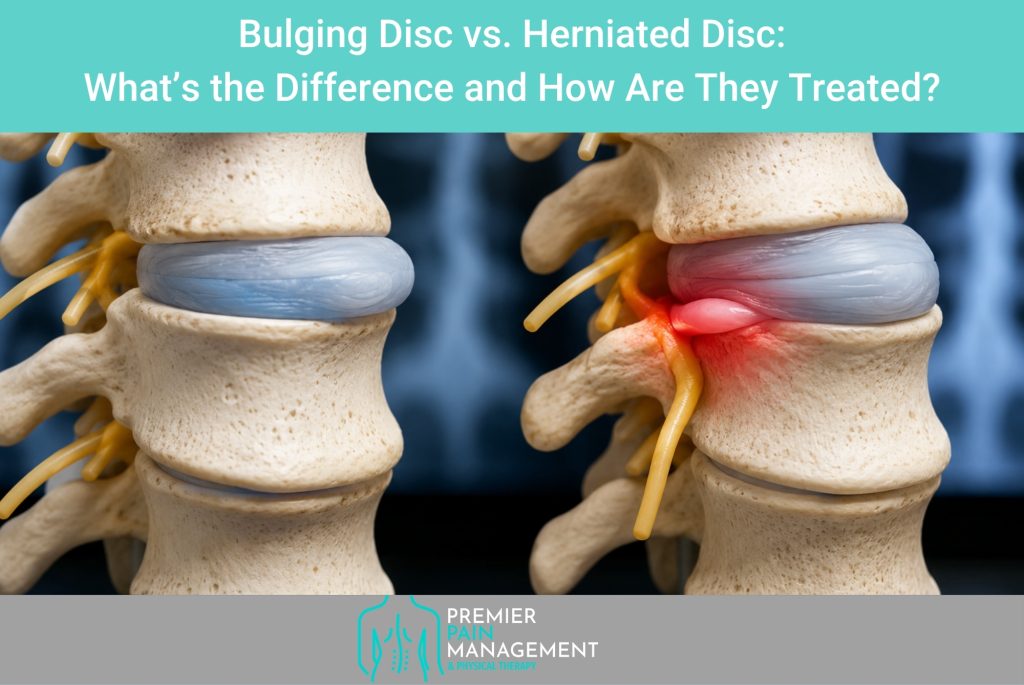
A bulging disc occurs when the outer portion of an intervertebral disc extends beyond its usual boundary. The disc generally remains intact, but a broader section of its circumference projects outward.
An analogy is a hamburger that is compressed between two buns, causing its edges to extend outward. Similarly, pressure and degeneration can cause a spinal disc to expand beyond the normal margins of the vertebral bodies.
Disc bulging is particularly common as people age and may appear on imaging even in individuals who have no pain.
Does a Bulging Disc Always Cause Pain?
No. Some bulging discs produce no symptoms and are discovered incidentally during an MRI or another imaging study performed for an unrelated reason.
Symptoms are more likely to develop when a bulging disc contributes to inflammation, affects nearby spinal structures, or narrows the space available for a spinal nerve.
What Is a Herniated Disc?
How Is a Herniated Disc Different?
A herniated disc occurs when disc material becomes displaced through a weakened or damaged portion of the outer annulus.
Depending on the extent and configuration of the displaced material, clinicians may describe a disc herniation using terms such as protrusion, extrusion, or sequestration.
A herniation tends to involve a more localized area of the disc than a broad disc bulge.
Why Can a Herniated Disc Cause Nerve Pain?
The spinal nerve roots travel through relatively confined spaces. Herniated disc material can irritate or compress a nearby nerve root.
Inflammatory substances associated with disc material may also contribute to nerve irritation. As a result, symptoms can occur even when mechanical compression is not severe.
When a lumbar nerve root is affected, patients may develop pain extending from the lower back or buttock into the leg. This pattern is commonly referred to as sciatica.
A cervical herniated disc can similarly produce symptoms that travel from the neck into the shoulder, arm, or hand.
Bulging Disc vs. Herniated Disc: The Key Differences
Disc Structure
With a bulging disc, the outer disc typically extends outward over a relatively broad area.
With a herniated disc, part of the inner disc material pushes through or beyond a weakened area of the outer disc.
Location and Extent
Disc bulges commonly involve a broader portion of the disc circumference. Herniations are typically more focal.
The size of the abnormality, however, does not necessarily predict the severity of a patient’s symptoms.
Symptoms
Either condition can be asymptomatic.
When symptoms occur, both bulging and herniated discs may cause localized spinal pain or symptoms associated with nerve irritation.
A herniated disc may be more likely to cause significant nerve-related symptoms when displaced disc material affects a nerve root.
Treatment
Treatment for both conditions depends more on the patient’s symptoms, neurological findings, functional limitations, and response to previous treatments than on terminology alone.
An MRI finding should therefore be interpreted in combination with a patient’s medical history and physical examination.
What Are the Symptoms of a Bulging or Herniated Disc?
Lower Back Symptoms
When a disc problem occurs in the lumbar spine, symptoms may include lower back pain, stiffness, muscle spasms, or discomfort aggravated by certain movements or positions.
Sciatica and Radiating Leg Pain
If a lumbar disc irritates a nerve root, pain may travel into the buttock, thigh, calf, or foot.
The location of the symptoms can sometimes help a physician determine which nerve root may be involved.
Numbness and Tingling
Nerve irritation may produce sensations described as tingling, pins and needles, burning, or numbness.
These symptoms can occur in the arms or hands when a cervical nerve is affected and in the legs or feet when a lumbar nerve is involved.
Muscle Weakness
More significant nerve involvement can interfere with the signals controlling specific muscles.
Patients may notice weakness when gripping an object, lifting an arm, raising the foot, climbing stairs, or performing other movements.
New or progressive weakness warrants prompt medical evaluation.
Neck and Arm Pain
A cervical bulging or herniated disc may cause neck pain that extends into the shoulder blade, shoulder, arm, or hand.
Symptoms can vary according to which cervical nerve root is irritated.
What Causes Bulging and Herniated Discs?
Age-Related Disc Degeneration
Intervertebral discs naturally undergo structural changes with age. They gradually lose hydration and elasticity, making them less capable of absorbing mechanical stress.
This process is known as disc degeneration.
Repetitive Stress
Repeated bending, twisting, lifting, pushing, or pulling can place additional stress on spinal structures.
People with physically demanding occupations may therefore experience significant cumulative spinal stress.
Sudden Injury
A forceful movement, fall, accident, or improperly performed heavy lift can sometimes contribute to a disc injury.
Sedentary Lifestyle
Long periods of sitting can increase stress on portions of the lumbar spine. Reduced physical conditioning can also affect the muscles responsible for supporting and stabilizing the spine.
Genetics
Some people have a greater inherited susceptibility to degenerative disc changes. Consequently, disc problems can occasionally develop even in relatively young adults.
How Are Bulging and Herniated Discs Diagnosed?
Medical History
Diagnosis begins with a detailed discussion of the patient’s symptoms.
A physician may ask when the pain started, what makes it better or worse, whether pain travels into an extremity, and whether numbness, tingling, or weakness is present.
Physical Examination
The physical examination may evaluate spinal movement, tenderness, muscle strength, sensation, reflexes, walking patterns, and signs of nerve irritation.
These findings help determine whether symptoms are likely related to a particular spinal nerve.
MRI
Magnetic resonance imaging (MRI) provides detailed images of discs, nerves, and other soft tissues.
An MRI can identify disc degeneration, bulging, herniation, spinal stenosis, and other structural abnormalities.
However, imaging results must be interpreted carefully. Disc abnormalities can be found in people without pain, so the most important question is whether an imaging finding corresponds with the patient’s symptoms and examination.
Other Diagnostic Testing
Depending on the patient’s symptoms and medical history, additional studies may be appropriate.
These can include X-rays, CT imaging, or electrodiagnostic testing such as electromyography (EMG) and nerve conduction studies.
How Are Bulging and Herniated Discs Treated?
Conservative Treatment
For many patients, treatment begins conservatively.
The goal is to control pain and inflammation while allowing the patient to remain as active as safely possible.
A treatment plan may include activity modification, appropriate exercise, physical therapy, medications, and changes to daily activities that aggravate symptoms.
Physical Therapy and Therapeutic Exercise
Physical therapy can help improve spinal mobility, core strength, posture, flexibility, and movement mechanics.
A therapist may also teach strategies for lifting, sitting, standing, and performing occupational activities while reducing unnecessary spinal stress.
Medications
Depending on a patient’s medical history and symptoms, medications may be considered to help control pain and inflammation.
Because every medication has potential benefits, risks, contraindications, and interactions, treatment should be individualized.
Interventional Pain Management for Disc-Related Pain
Epidural Steroid Injections
When an inflamed spinal nerve is contributing to significant radiating pain, an epidural steroid injection may be considered.
The procedure delivers medication into the epidural space near the affected spinal nerves with the goal of reducing inflammation and pain.
Epidural injections do not physically repair the disc. Instead, reducing nerve inflammation may provide symptom relief and allow some patients to participate more effectively in rehabilitation.
Targeted Treatment Based on the Source of Pain
Not every person with a disc abnormality has pain caused directly by that disc.
Other spinal structures—including facet joints, sacroiliac joints, muscles, and nerves—can produce overlapping symptoms.
For this reason, an accurate diagnosis is essential before determining whether an interventional procedure is appropriate.
Do Bulging and Herniated Discs Heal?
The Body Can Improve Without Surgery
Many cases of disc-related pain improve over time with nonsurgical care.
Inflammation around an affected nerve may decrease, and the body can sometimes gradually resorb portions of herniated disc material.
The timeframe varies considerably. Some patients improve relatively quickly, while others experience persistent or recurrent symptoms requiring additional treatment.
A Disc Does Not Have to Look Perfect for You to Feel Better
Clinical recovery and imaging findings are not always identical.
A patient can experience substantial improvement in pain and function even when an MRI continues to show degenerative changes or a disc abnormality.
Treatment therefore focuses on improving symptoms and function rather than simply attempting to normalize an imaging study.
When Is Surgery Considered for a Herniated Disc?
Most Patients Do Not Automatically Need Surgery
Finding a herniated disc on an MRI does not by itself mean spinal surgery is required.
Nonsurgical treatments are often considered first when there is no medical emergency or progressive neurological deficit.
When Surgical Evaluation May Be Appropriate
A surgical consultation may be appropriate when severe symptoms persist despite appropriate nonsurgical care or when significant neurological impairment develops.
Progressive muscle weakness, for example, deserves prompt evaluation.
What Symptoms Require Immediate Medical Attention?
Warning Signs of a Serious Neurological Problem
Most bulging and herniated discs are not medical emergencies. Certain symptoms, however, can indicate significant nerve compression.
Seek immediate medical attention for new loss of bowel or bladder control, numbness around the groin or inner thighs (sometimes called saddle anesthesia), rapidly progressive leg weakness, or other severe neurological changes.
These symptoms may indicate cauda equina syndrome or another serious condition requiring emergency assessment.
Preventing Future Disc Problems
Use Proper Lifting Mechanics
When lifting, keep the object close to the body, use the legs appropriately, and avoid simultaneously bending and twisting whenever possible.
Stay Physically Active
Regular physical activity can support muscular strength, mobility, cardiovascular health, and healthy body weight.
The best exercise program depends on individual health, symptoms, and physical abilities.
Strengthen Your Core
The abdominal, back, pelvic, and hip muscles help stabilize the spine during everyday movements.
Appropriate strengthening exercises may help improve spinal support and movement control.
Pay Attention to Ergonomics
People who spend substantial time sitting should consider workstation positioning, chair support, monitor height, and opportunities to change positions regularly.
No single posture needs to be maintained perfectly throughout the day. Regular movement and position changes are important.
Frequently Asked Questions About Bulging and Herniated Discs
Is a Bulging Disc the Same as a Herniated Disc?
No. A bulging disc generally extends outward across a broader portion of its circumference, while a herniated disc involves more focal displacement of disc material through a weakened area of the outer disc.
Which Is Worse: A Bulging Disc or a Herniated Disc?
Neither diagnosis is automatically worse.
A relatively small disc abnormality can cause substantial symptoms if it irritates a nerve, while a larger abnormality may cause little or no discomfort.
Symptoms and neurological findings are more clinically important than the terminology alone.
Can a Bulging Disc Turn Into a Herniated Disc?
Disc degeneration can progress over time, and a weakened disc can potentially develop a more focal herniation. However, a bulging disc does not inevitably become herniated.
Can a Herniated Disc Heal Without Surgery?
Yes. Many patients with herniated discs improve with nonsurgical treatment. In some cases, herniated disc material may decrease in size over time as the body resorbs portions of it.
Can a Bulging Disc Cause Sciatica?
Yes. A lumbar disc bulge can contribute to sciatica when it irritates or compresses a nerve root associated with the sciatic nerve.
What Does Sciatica Feel Like?
Sciatica commonly causes pain that begins in the lower back or buttock and travels down one leg. Patients may describe the pain as burning, shooting, electric, sharp, or aching.
Numbness, tingling, or weakness may also occur.
Can a Herniated Disc Cause Neck and Arm Pain?
Yes. A herniated disc in the cervical spine can irritate a cervical nerve root, potentially causing pain, numbness, tingling, or weakness extending from the neck into the shoulder, arm, or hand.
Do I Need an MRI for Back Pain?
Not everyone with back pain requires immediate imaging.
A physician determines whether an MRI or another imaging study is appropriate based on symptoms, examination findings, duration of pain, previous treatment, neurological findings, and potential warning signs.
Can an Epidural Steroid Injection Fix a Herniated Disc?
An epidural steroid injection does not physically repair or replace the disc. Its purpose is generally to reduce inflammation around irritated spinal nerves and help relieve radiating pain.
For appropriate patients, improved pain control may make rehabilitation and normal activities easier.
How Long Does a Herniated Disc Take to Improve?
Recovery varies significantly. Some patients improve within weeks, while others experience symptoms for several months or longer.
The location and severity of nerve irritation, general health, activity demands, and response to treatment can all influence recovery.
Should I Rest if I Have a Herniated Disc?
Short-term activity modification may be helpful during an acute pain episode, but prolonged bed rest is generally not the goal for most uncomplicated cases.
A healthcare professional can provide guidance about safe movement and gradual return to normal activities based on the individual’s condition.
Can Sitting Make a Herniated Disc Hurt More?
For some patients, prolonged sitting aggravates lumbar disc-related symptoms. Regular position changes, appropriate ergonomics, and movement breaks may help.
Can I Exercise With a Bulging Disc?
Many people with disc abnormalities can exercise safely, but the appropriate activities depend on symptoms and the location and severity of the problem.
Patients with significant pain, numbness, weakness, or neurological symptoms should obtain medical guidance before beginning or substantially changing an exercise program.
When Should I See a Pain Management Specialist?
Consider an evaluation when back or neck pain persists, repeatedly returns, interferes with sleep or daily activities, or is accompanied by pain radiating into an arm or leg.
Numbness, tingling, or weakness also warrants medical evaluation, particularly when symptoms are new or worsening.
Get Help for Back, Neck, and Disc-Related Pain in Highlands Ranch, CO
A bulging or herniated disc can interfere with work, exercise, sleep, and everyday activities, but an abnormal MRI does not automatically mean surgery is necessary.
The key is determining whether the disc abnormality is actually responsible for your symptoms and identifying which treatment approach is appropriate for your individual condition.
Premier Pain Management provides evaluation and treatment for patients experiencing back pain, neck pain, sciatica, radiating nerve pain, and other painful conditions. A personalized pain management plan may incorporate conservative therapies and interventional treatment options based on the patient’s diagnosis, symptoms, health history, and treatment goals.
If persistent back or neck pain is affecting your daily life, schedule an evaluation with Premier Pain Management in Highlands Ranch to discuss your symptoms and available treatment options.
Contact Information
Premier Pain Management
8671 S Quebec St. Suite 150
Highlands Ranch, CO 80130
Phone: (303) 683-6868
Website: premierpaingroup.com
Appointments: premierpaingroup.com/appointments/
Meta Title
Bulging Disc vs. Herniated Disc | Highlands Ranch, CO
Meta Description
Learn the difference between a bulging disc and herniated disc, common symptoms, diagnosis, and treatment options from Premier Pain Management in Highlands Ranch, CO.